

Whitening Toothpaste in the UK — Top 5 Picks for 2026
Whitening toothpaste is a popular category of daily oral care products designed to remove surface stains and help teeth appear brighter without professional treatment. In the UK market, consumers choose whitening toothpastes for convenience, affordability and the promise of a whiter smile that fits into regular brushing routines. Recent preferences favour formulas that balance stain-removal power with enamel safety: low-abrasivity silica polishers, peroxide-free chemical stain removers, fluoride protection and options for sensitive teeth. Shoppers in 2026 also look for transparency about ingredients, sustainability in packaging, cruelty-free and vegan labels, and products from trusted brands or recommended by dental professionals.
Inception's AI took the time to understand this market in the UK · We may earn a commission on purchases. It never affects our rankings.
Top Picks Summary
Colgate Max White Ultra Active Foam
Colgate Max White Ultra Active Foam earns its spot as a best-in-class whitening toothpaste by combining aggressive foaming coverage with accessible mass-market pricing, making it a cost-effective choice for users who want wide enamel contact and daily stain control. Compared with the more specialized polishing or sensitivity formulas on this list, Colgate’s technical advantage is its active-foam delivery that helps spread whitening agents quickly, offering strong value per tube for general-use whitening needs.

Where to buy Colgate Max White Ultra Active Foam in UK: we track one retailer, Colgate, and show the price we last observed there; the price you see at checkout may differ.
We may earn a commission on purchases. It never affects our rankings.
£3 – £5
Oral-B 3D White Luxe Perfection
Oral-B 3D White Luxe Perfection is positioned as a market-leading, premium whitening paste that emphasizes micro-polishing technology to lift surface stains while preserving enamel, giving it a technical edge over basic abrasive formulas. It typically carries a higher price than the value-focused brands here but competes by promising more visible polish and sustained brightness versus foam- or baking-soda-based competitors.

Sensodyne True White
Sensodyne True White holds a leadership role for consumers who need whitening without compromising sensitivity protection, blending gentler polishing or peroxide-based whitening with desensitizing agents that clinically address dentinal hypersensitivity. Financially and technically, it sits at the upper-middle price tier because it doubles as a therapeutic product—unlike pure cosmetic whiteners on the list—making it the go-to option for whitening when sensitivity is a concern.

Where to buy Sensodyne True White in UK: we track one retailer, Sensodyne-me, and show the price we last observed there; the price you see at checkout may differ.
We may earn a commission on purchases. It never affects our rankings.
£5 – £9
Arm & Hammer Advanced White
Arm & Hammer Advanced White leverages baking soda’s stain-lifting and neutralizing chemistry to offer an affordable, technically straightforward whitening approach that also targets odor and surface discoloration. Its main financial advantage is strong value—often lower cost per tube—while its technical distinction lies in sodium bicarbonate’s mild abrasion and cleansing action, making it a practical alternative to pricier micro-polisher or peroxide-based whites.
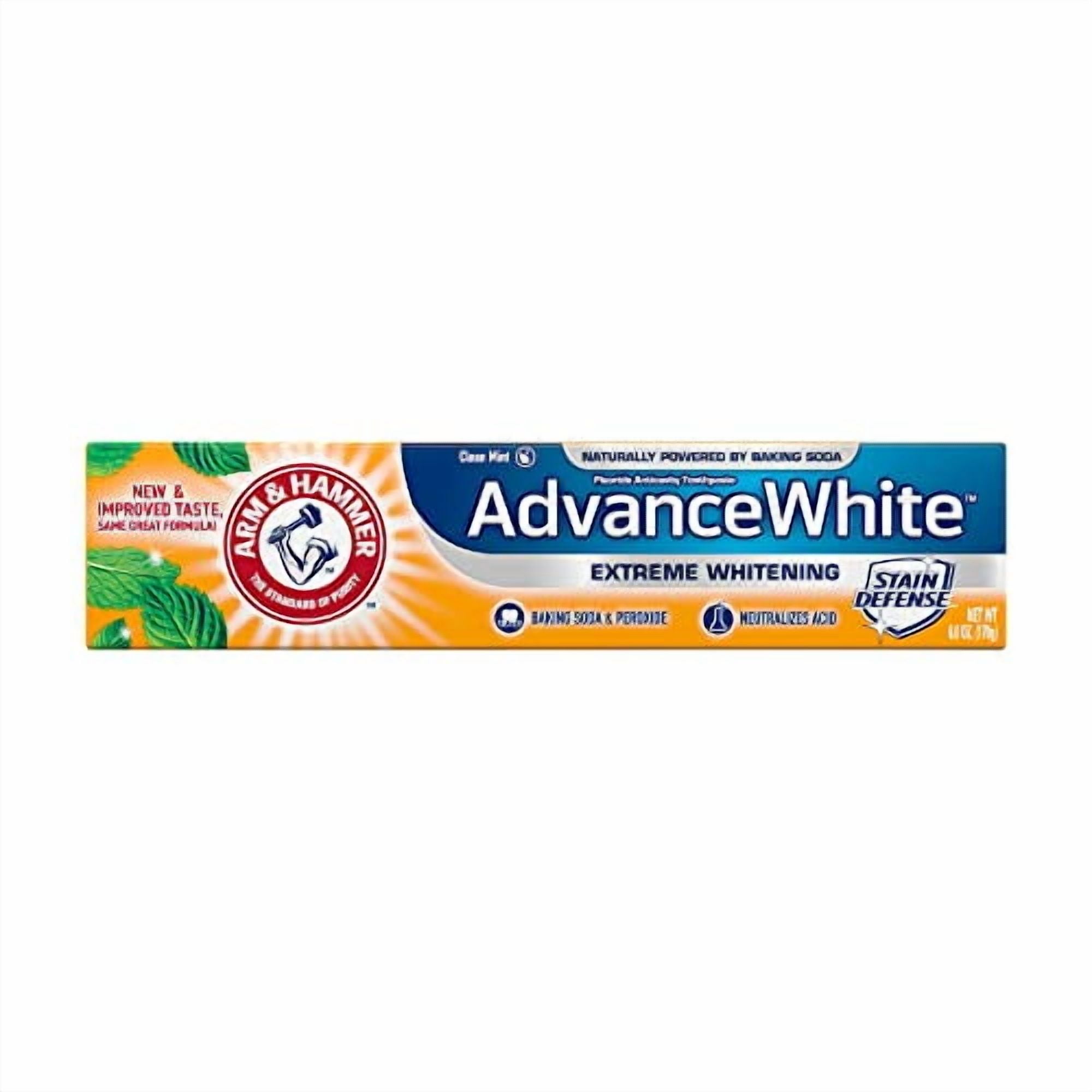
Where to buy Arm & Hammer Advanced White in UK: we track one retailer, Armandhammer, and show the price we last observed there; the price you see at checkout may differ.
We may earn a commission on purchases. It never affects our rankings.
£3 – £6
How whitening toothpastes work and what the research says
Whitening toothpastes primarily remove extrinsic stains from coffee, tea, red wine and tobacco through physical and chemical action. Physical stain removal uses mild abrasives such as hydrated silica to polish the tooth surface. Some formulas include low levels of peroxide or other chemical stain-modifying agents to break down stain molecules. Optical brighteners and mild enzymes are also used in some products to improve the appearance of whiteness. Clinical studies and reviews indicate that whitening toothpastes can provide noticeable improvement in surface staining over weeks of regular use, but they do not achieve the same degree of whitening as professional in-office bleaching. Safety and effectiveness depend on formulation: abrasion level, presence of fluoride, and ingredient quality.
Abrasives (for example, silica) remove extrinsic surface stains effectively when formulations keep abrasivity within safe limits.
Peroxide-based ingredients at low concentrations can contribute to modest whitening, but stronger bleaching agents are typically regulated and used only under dental supervision.
Fluoride in whitening toothpastes remains important to protect enamel against decay while polishing agents work on stains.
Activated charcoal and some novel natural ingredients are popular but have limited high-quality evidence for whitening and may be more abrasive.
Studies show whitening toothpastes improve surface stain over time but are not a substitute for professional bleaching for deep intrinsic discolouration.
Some users may experience increased tooth sensitivity or gum irritation; choosing sensitivity-friendly formulas or consulting a dentist helps reduce risk.
Frequently Asked Questions
Which whitening toothpaste is best for daily stain control?
Colgate Max White Ultra Active Foam is the ideal choice for daily stain control because its expanding active foam reaches between teeth to lift surface stains effectively.
Does Oral-B 3D White Luxe Perfection use micro-polishing technology?
Yes, Oral-B 3D White Luxe Perfection uses micro-polishers and silica to remove surface stains and provide a polished finish while remaining enamel-safe.
What is the average customer rating for Colgate Max White Ultra?
Colgate Max White Ultra Active Foam holds an average rating of 4.4 out of 5 stars from users.
Is Sensodyne True White suitable for people with sensitive teeth?
Sensodyne True White is specifically designed for people with sensitivity concerns, as it uses a low-abrasion formula to whiten teeth without triggering dentinal hypersensitivity.
Conclusion
Whitening toothpastes remain a practical, everyday option for reducing surface stains and brightening smiles across the UK. We hope this overview helped you understand the category and what to look for. If you did not find exactly what you wanted, you can refine or expand your search using the search box to filter by sensitivity, ingredients, sustainability or brand.