

Compact Broadcast Camcorders — UK Guide 2026 (Top 5 Picks)
Published on Monday, 26 January 2026
Compact broadcast camcorders combine professional image quality with a small, mobile form factor, making them ideal for field reporting, live streaming and small-scale production across the UK. In 2026 buyers still prioritise portability, reliable low-light performance, robust connectivity (NDI, SDI, HDMI, IP streaming) and flexible codec support for efficient workflows. UK customers — from broadcasters and freelance journalists to corporate media teams, churches and event producers — favour models that balance durable build and ergonomic handling with broadcast-grade sensors, autofocus and integrated streaming features. These camcorders appeal because they reduce setup time, fit into tight shooting environments, and enable quick turnaround for news, sport and live events without the footprint and complexity of studio cameras.
Top Picks Summary
Sony PXW-Z90V
The PXW-Z90V is Sony's compact, premium 4K broadcast camcorder known for fast hybrid autofocus, broad codec support and broadcast-grade color profiles, making it best-in-class for run-and-gun and multi-camera workflows. Compared with the other compact models in this list it sits at a higher price point but delivers superior AF reliability, low-light performance and flexible recording options that justify the investment for broadcasters needing consistent 4K acquisition and fast turnaround.

Canon XA75
The XA75 is Canon's market-leading compact camcorder for value-conscious broadcasters, offering dependable Canon color science and intuitive autofocus in a small, affordable package. It typically undercuts the Sony and Panasonic models on purchase price while delivering predictable skin tones and efficient file handling, although it trades off some of the advanced networking and codec flexibility found on the AG-CX10 and Z90V.

Panasonic AG-CX10
The AG-CX10 stands out as the most network- and live-production-ready compact camcorder here, with built-in IP/streaming capabilities and professional connectivity that simplify remote workflows for broadcasters. Technically it offers stronger integrated streaming and routing features than the Canon and Sony entries, and its competitive pricing makes it the sensible choice when integrated live delivery and flexible I/O matter more than the very latest autofocus or sensor tweaks.

Sony PXW-Z150
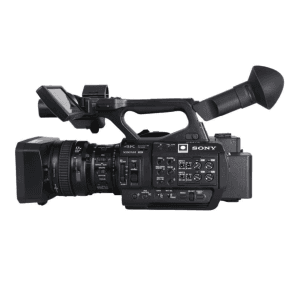
The PXW-Z150 remains a dependable, cost-effective compact broadcast camcorder favored for its long optical reach, rugged build and professional I/O at a lower street price than the Z90V. It does not match the Z90V's autofocus sophistication or the CX10's embedded streaming tools, but it delivers reliable 4K recording and value for crews that need zoom and straightforward workflows without premium extras.
Canon XA65
The XA65 is a practical mid-market compact broadcast camcorder that balances purchase price, image quality and onboard stabilization, bringing Canon's color and ergonomic controls to solo operators and small crews. While it lacks some high-end features such as the Z90V's advanced AF or the CX10's integrated IP streaming, its affordability and efficient recording workflow make it an attractive option for freelancers and smaller stations.

What research and testing say
Scientific and industry testing supports the practical benefits of compact broadcast camcorders. Imaging research, ergonomics studies and field tests consistently show how sensor size, image processing and design choices affect image quality, operator comfort and real-world reliability. Below are approachable summaries of the findings most relevant to buyers.
Sensor size and pixel technology: Laboratory imaging tests demonstrate that larger sensors and newer back-illuminated CMOS architectures improve low-light sensitivity and dynamic range, giving cleaner images in dim conditions common in live events.
Image processing and codecs: Controlled benchmarks show that modern codecs and hardware encoders preserve detail while lowering file sizes, enabling faster transfers and longer recordings on the same media without a large hit to quality.
Autofocus and stabilization: Field trials indicate that reliable hybrid autofocus and built-in image stabilisation significantly reduce operator error and the need for re-shoots, especially for solo operators and run-and-gun scenarios.
Ergonomics and fatigue: Human factors research finds that lighter, better-balanced cameras reduce operator fatigue and improve handheld steadiness during long shoots, which boosts overall production efficiency.
Battery and power systems: Tests across battery chemistries and power-management systems show improvements in runtime and predictable performance, important for location shoots where mains power is unavailable.
Networked workflows: Industry evaluations of IP streaming and NDI-style protocols confirm that integrated network features simplify live production and remote-control setups, reducing the need for external encoders or complex cabling.
Frequently Asked Questions
Which compact broadcast camcorder fits run-and-gun multi-camera?
Sony PXW-Z90V suits run-and-gun and multi-camera workflows thanks to fast hybrid autofocus, a versatile 12x optical zoom lens, and built-in Ethernet/Wi‑Fi for live IP streaming; it has a 4.3 average rating.
Does Panasonic AG-CX10 support NDI|HX streaming?
Yes—Panasonic AG-CX10 is listed with NDI|HX streaming, and its key features include native IP streaming with network protocols for low-latency live transmission; it’s rated 4.1 on average.
How does Canon XA75 compare on price and features?
The provided data doesn’t include a price for Canon XA75, but it says the XA75 typically undercuts the Sony and Panasonic models on purchase price while offering 1.0-inch CMOS 4K capture, Dual Pixel autofocus, and dual memory card slots.
What sensor size do Sony PXW-Z90V and Canon XA75 share?
Both Sony PXW-Z90V and Canon XA75 use a 1.0-inch Exmor-type/CMOS sensor respectively for 4K imaging; Sony is rated 4.3 and Canon is rated 4.3.
Conclusion
Compact broadcast camcorders remain a practical choice across the UK for sellers and creators who need broadcast-capable results with minimal bulk. We hope this guide helped clarify what to look for — if you want to refine or expand your search, use the site search to filter by features, price, brand or availability.