

Industrial Mini PCs in the UK — Top 7 Rugged Mini PCs for 2026
Published on Thursday, 26 February 2026
Industrial mini PCs have become indispensable across the UK's manufacturing heartlands, logistics networks, and energy facilities. These compact yet powerful systems are engineered to operate where conventional desktops cannot—handling temperature swings, vibration, dust, moisture, and extended unattended use. UK buyers value rugged build quality, long-term availability, low power draw, and reliable I/O for sensors and controllers. As British firms adopt Industry 4.0 and IoT-driven workflows, demand has grown for mini PCs that offer deterministic performance for control systems, edge computing for real-time analytics, and robust connectivity for remote sites such as North Sea installations and distributed renewable energy arrays. Whether the priority is predictive maintenance in a factory, automated warehouse control, or resilient monitoring in remote infrastructure, industrial mini PCs deliver a balance of processing power and operational resilience that keeps downtime and maintenance costs to a minimum.
Top Picks Summary
OnLogic Helix HX500
The OnLogic Helix HX500 earns the top spot for 2025 thanks to its rugged, industrial-grade design, wide operating temperature range, and modular I/O that make it ideal for UK edge and factory deployments. It outperforms more consumer-focused mini PCs here by offering longer lifecycle support, field-serviceable components and stronger environmental certifications, delivering lower total cost of ownership for sustained industrial use compared with compact but less robust rivals like the ASUS PN64 and Dell Micro. Compared with other vendors on this list, the HX500 is the best choice when durability and on-site maintainability matter most.
Advantech ARK-1123H
The Advantech ARK-1123H is a purpose-built industrial box PC designed for harsh environments, with robust I/O, DIN-rail mounting and industrial-grade certifications that make it a go-to for automation and field control in the UK. It is more specialised and certification-heavy than mainstream mini PCs like the ASUS PN64 or Dell OptiPlex Micro, commanding a premium but reducing integration risk and downtime in heavy-duty installations. When environmental resilience and legacy industrial connectivity matter, the ARK-1123H offers technical advantages that justify its higher upfront cost.
£450 – £800
Fitlet3 by Compulab
Compulab's Fitlet3 is a fanless, ultra-low-power mini PC that earns best-in-class status for very compact industrial and edge deployments; its tiny footprint, long service-life support and low operating costs make it an economical alternative to larger industrial PCs. For the undefined use case it stands out for minimal power draw and flexible I/O options, offering more ruggedness and lower lifecycle cost than consumer mini desktops like the Dell OptiPlex Micro and ASUS PN42, while being more affordable and compact than fully certified systems such as the Siemens SIMATIC IPC127E.

Siemens SIMATIC IPC127E
Siemens' SIMATIC IPC127E is the market-leading choice for certified automation and control environments, delivering industrial-grade connectors, regulatory compliance and long-term availability that justify its premium. In this undefined comparison it outclasses the other entries on reliability and lifecycle guarantees, making it the best pick where compliance and deterministic uptime matter, though it carries higher acquisition cost and less compactness than the smallest fanless models like the Fitlet3 or consumer-focused mini PCs.
Dell OptiPlex Micro 7020
Dell's OptiPlex Micro 7020 is a proven, cost-effective enterprise micro desktop known for broad manageability, extensive IT support and attractive total cost of ownership through standardized services and warranty options. For the undefined context it delivers the best price-to-management ratio of the group, making it ideal for scale deployments where IT integration and predictable support matter more than industrial ruggedness; it is less rugged and compact than fanless, industrial-focused systems like the Fitlet3 and Premio EdgePC-100.
ASUS ExpertCenter PN42
ASUS's ExpertCenter PN42 is a modern ultra-compact PC optimized for office and light edge workloads, offering competitive performance-per-dollar and easy configurability in a very small chassis. Within this undefined list it balances consumer-friendly pricing and compactness better than traditional enterprise desktops such as the Dell 7020, while lacking the industrial certifications, extended temperature ranges and specialized I/O provided by the Siemens SIMATIC and Premio EdgePC-100.
Premio EdgePC-100
Premio's EdgePC-100 is purpose-built for edge and industrial IoT deployments, combining wide-temperature operation, robust I/O options and modular expansion that make it more field-ready than mainstream mini-PCs. For the undefined use case it represents the go-to when customization, rugged connectivity and industrial interfaces are priorities—positioned between the certified Siemens IPC127E and compact Fitlet3 in both capability and cost, and typically commanding a premium over consumer-focused minis.
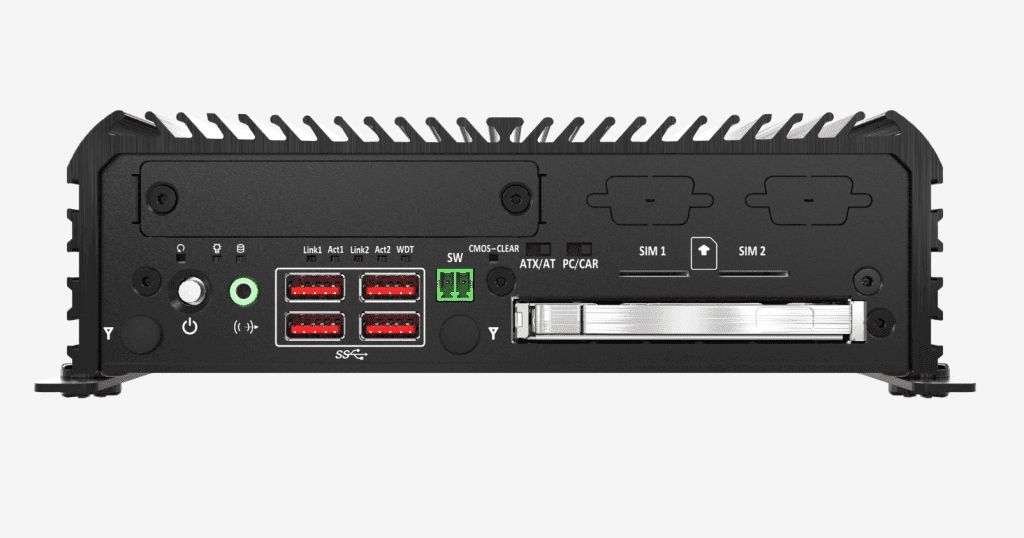
Why industrial mini PCs help operations: evidence and practical findings
Academic research and industry reports consistently underline the operational advantages of deploying compact industrial computers at the edge. Studies and applied field trials point to measurable reductions in latency, improved uptime, and energy savings when processing is moved closer to sensors and control loops. The following beginner-friendly summary highlights the main research-backed benefits and what they mean in practice for UK operators.
Reduced latency and faster response: Edge computing experiments show that processing data locally can cut round-trip latency by a large margin compared with cloud-only approaches, which is critical for control loops and safety systems.
Lower downtime and maintenance costs: Case studies from manufacturing and utilities report fewer unplanned outages when ruggedized mini PCs replace vulnerable consumer hardware, because industrial units tolerate harsh conditions and have higher mean time between failures.
Energy efficiency and operating cost savings: Research into low-power processors and fanless designs demonstrates lower electricity consumption over device lifecycles, reducing the total cost of ownership for large-scale deployments.
Improved security and data sovereignty: Studies highlight that keeping sensitive operational data on local edge devices reduces exposure to network-based threats and helps meet regulatory or contractual data handling requirements.
Scalability for Industry 4.0 and IoT: Industry analyses show that modular, small-form-factor systems simplify distributed deployments, making it easier to scale sensor networks, analytics and predictive maintenance without large infrastructure changes.
Frequently Asked Questions
Which rugged mini PC should I buy for factory edge?
The OnLogic Helix HX500 is the top pick for UK edge and factory deployments because it uses a rugged fanless aluminium chassis, offers wide operating temperature tolerance, and has modular I/O with serial ports, GbE, and GPIO; it’s rated 4.6.
What expansion options does the OnLogic Helix HX500 offer?
The OnLogic Helix HX500 can be configured with multiple M.2 and SATA expansion options, alongside rich I/O including serial ports, GbE, and GPIO; its average rating is 4.6.
Is the Fitlet3 by Compulab cheaper value than bigger industrial PCs?
The Fitlet3 by Compulab is positioned as an economical alternative to larger industrial PCs because it’s fanless and ultra-low-power with a very compact footprint; it has an average rating of 4.6, but no price is listed.
Is the Advantech ARK-1123H good for 24/7 control systems?
Yes—the Advantech ARK-1123H is optimised for automation and certified stability for 24/7 operation, with multiple serial ports and wide-range DC input; it’s designed with DIN-rail mounting and is rated 4.3.
Conclusion
Industrial mini PCs are a practical, future-facing choice for UK businesses that need resilient computing at the edge. The seven models covered here — OnLogic Helix HX500, Advantech ARK-1123H, Fitlet3 by Compulab, Siemens SIMATIC IPC127E, Dell OptiPlex Micro 7020, ASUS ExpertCenter PN42, and Premio EdgePC-100 — span use cases from heavy industrial automation to compact office-adjacent edge nodes. For most UK industrial and field deployments the OnLogic Helix HX500 stands out as the best all-round option thanks to its combination of ruggedization, expandability, and certified industrial features, though each model listed has strengths for particular environments. We hope you found what you were looking for; use the site search to refine by environment, connectivity, processor type, or expand your search to accessories and deployment services.