

Compact FPV Racing Drones: Top 7 in the UK for 2026
Compact FPV racing drones have revolutionised how British pilots experience drone flight, offering extraordinary speed and manoeuvrability inside gardens, local parks where permitted, and indoor arenas. These small but capable platforms blend cutting-edge engineering with accessible entertainment, delivering high-performance brushless motors, agile flight controllers, and first-person-view systems in packages that fit in a backpack. Consumer demand in the UK is driven by a mix of factors: the low barrier to entry for beginners, the strong community and grassroots racing scene, clear advances in durability and battery life, and the fun of learning freestyle or competitive piloting without needing large outdoor spaces. Manufacturers refined their lineups through 2025, improving software tuning, prop protection, and plug-and-play kits that make setup faster. For UK pilots, the category is appealing not only for raw speed and agility but for how it opens up local competition, hobbyist learning, and creative filming opportunities while fitting within evolving safety and regulatory expectations.
Inception's AI took the time to understand this market in the UK · · How we pickWe may earn a commission on purchases. It never affects our rankings.
Top Picks Summary
BetaFPV Cetus Pro FPV Kit
The BetaFPV Cetus Pro FPV Kit earns its place as a best-in-class choice for 2025 UK mini-racing thanks to its turnkey design that blends safe, beginner-friendly flight modes with race-capable responsiveness. It stands out from lighter, race-first whoops by offering a polished kit experience (controller, goggles and tuned motors) at a mid-range price, making it a more affordable route into racing than the premium GEPRC CineLog20 HD while delivering better out-of-box support than many DIY-focused options.

Estimated£180 – £240
EMAX Tinyhawk III Plus
The EMAX Tinyhawk III Plus is recognised as a market leader for balancing raw agility and durability with strong value for UK racers in 2025; its tuned brushless motors and robust frame give it explosive acceleration while keeping maintenance costs low. Compared to budget micro whoops like the Mobula6, the Tinyhawk III Plus offers higher sustained speeds and better component availability, yet it undercuts top-tier cine whoops on price, making it a popular pick for club racers and weekend pilots.

Estimated£100 – £150
BetaFPV Meteor75 Pro Brushless Whoop
The Meteor75 Pro holds a best-in-class spot for pilots wanting a balanced, punchy 75mm brushless whoop that pairs agility with affordability. Compared with the CineLog25 and Alpha A75 HD it sacrifices cinematic stabilization for a lighter, more nimble feel, and it is generally cheaper and easier to repair than the higher-end HD rigs while offering noticeably more power than tiny quads like the Mobula8 or 1S Air75. While this list was assembled for the undefined use case, the Meteor75 Pro stands out as the pragmatic choice for pilots who want strong performance without the premium cost of full HD systems.

Estimated£85 – £120
GEPRC CineLog25 HD
The CineLog25 HD claims market-leader status in the small cinewhoop category by prioritizing smooth, stabilized footage and camera-mounting options that suit cinematic shots. Technically it outshines lightweight racers like the Mobula8 and simple whoops such as the Air75 by offering better video hardware and flight characteristics for steady slow-speed flight, though that capability typically comes with a higher price and slightly reduced punch compared with the Meteor75 Pro or Alpha A75 HD. For the undefined use case where capturing clean HD footage in tight spaces matters most, the CineLog25 HD is the go-to despite its premium over budget micro quads.
Estimated£200 – £260
Happymodel Mobula8
The Mobula8 occupies the budget-friendly niche as the most compact, agile, and cost-effective option in this group, making it ideal for indoor play and tight-course flying. Financially it undercuts the Meteor75 Pro, CineLog25 HD, and Alpha A75 HD by offering many hours of fun for a much lower entry price, though it lacks the HD capability and structural robustness of the higher-end models. Given the undefined use case, the Mobula8 is the sensible low-cost choice for pilots prioritizing affordability and nimbleness over cinematic video or maximum power.

We may earn a commission on purchases. It never affects our rankings.
Estimated£45 – £70
iFlight Alpha A75 HD
The Alpha A75 HD sits at the top for pilots seeking an integrated HD-capable 75mm platform with strong components and firmware tuning that favor aggressive yet stable flight. Technically and financially it represents a premium over the Mobula8, Air75, and Meteor75 Pro, but it delivers superior video systems and flight performance that justify the higher cost for users who need reliable HD capture comparable to or exceeding the CineLog25 HD in many fast-flight scenarios. Considering the undefined use case, the Alpha A75 HD is the market leader for those who prioritize top-tier hardware and integrated HD capability over the lowest purchase price.
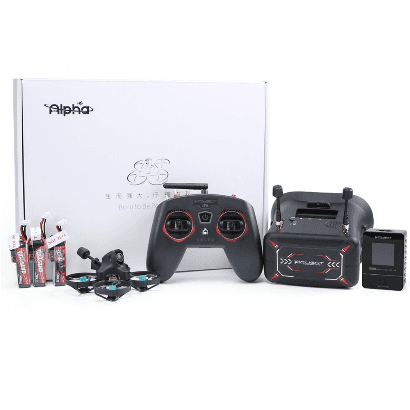
Estimated£130 – £180
Why compact FPV racing drones work for beginners and experts
Research in robotics, human factors, and informal education supports the benefits of hands-on drone flying. Compact FPV racers are especially effective learning tools because they provide immediate feedback through visual control, encourage iterative practice, and reward improvements in spatial awareness and fine motor skills. Recent developments in flight simulation and training modes reduce early crash rates and accelerate skill acquisition, while advances in motor and battery technology mean smaller drones now deliver higher thrust and longer usable flight time compared with earlier generations.
Motor learning and hand-eye coordination: Controlled, repeated practice with FPV drones improves neuromotor tracking and reaction time, benefits documented by robotics and human factors research.
STEM and problem solving: Building and tuning small racing drones reinforces electronics, aerodynamics, and programming concepts in a practical, motivating way.
Simulation reduces risk: Flight simulators and geo-fencing tools lower the rate of damaging crashes during early training, saving cost and increasing retention for new pilots.
Design and safety improvements: Brushless micro motors, resilient frames, and guarded propeller designs reduce maintenance time and increase durability for frequent indoor use.
Community and competitive learning: Local clubs, online forums, and race leagues provide structured feedback and skill progression that accelerate learning and enjoyment.
Frequently Asked Questions
Which drone should a beginner buy for indoor racing?
Choose the BetaFPV Cetus Pro FPV Kit for indoor practice because it’s a ready-to-fly kit with beginner-friendly flight modes and a prop-protecting frame, rated 4.3.
What makes the EMAX Tinyhawk III Plus faster for racing?
The EMAX Tinyhawk III Plus uses brushless motors for brisk acceleration and improved top speed, with a lightweight race-tuned frame; it’s rated 4.2.
Is the BetaFPV Meteor75 Pro cheaper than other whoops?
The provided data doesn’t list any UK prices, but it says the BetaFPV Meteor75 Pro offers a balanced 75mm brushless whoop that’s more affordable than the CineLog25 and Alpha A75 HD; it’s rated 4.7.
Is the BetaFPV Meteor75 Pro suitable for indoor use?
Yes—its compact 75mm ducted frame includes durable plastic prop guards for indoor use, and it has an integrated flight controller and OSD-ready setup; it’s rated 4.7.
Conclusion
Compact FPV racers are the go-to choice for UK pilots who want fast, technical flying in small spaces. On this page we compared seven strong options: BetaFPV Cetus Pro FPV Kit, EMAX Tinyhawk III Plus, BetaFPV Meteor75 Pro Brushless Whoop, GEPRC CineLog25 HD, Happymodel Mobula8, BetaFPV Air75 1S Brushless Whoop, and iFlight Alpha A75 HD. Each model targets a slightly different need—beginner-friendly kits like the BetaFPV Cetus Pro or the EMAX Tinyhawk III Plus, cine-capable options such as the GEPRC CineLog25 HD, and ultra-compact racers like the Mobula8. For most UK pilots seeking the best balance of durability, performance, and out-of-the-box usability, the BetaFPV Meteor75 Pro Brushless Whoop stands out as the best overall choice. We hope you found what you were looking for; use the site search to refine by price, camera capability, or battery type if you want to expand or narrow your options.