

Top 5 Upper Limb Rehabilitation Robots in the UK for 2026
Published on Tuesday, 27 January 2026
Upper limb rehabilitation robots are designed specifically for shoulder, arm, and hand therapy, promoting motor skills recovery through guided movements and structured exercises. In the UK market these systems are increasingly adopted by NHS trusts, private clinics and specialist rehabilitation centres because they deliver consistent, high-repetition practice, objective progress tracking, and adaptable therapy programs that suit stroke survivors, brain injury patients and others with motor impairments. Consumers and clinicians favour robotic solutions for their ability to combine evidence-based protocols with real-time feedback, gamified engagement and workload reduction for therapists. Key benefits include measurable improvements in range of motion and motor control, safer assisted movements for weak patients, and scalable therapy that supports both intensive in-clinic use and extended outpatient or community programmes.
Top Picks Summary
Armeo Power
Armeo Power is a clinician-focused upper-limb exoskeleton that delivers gravity compensation and high-torque assistance for shoulder, elbow and wrist training, making it a strong choice for patients with moderate to severe impairments. Its combination of robust actuation, adaptive assistance and immersive therapy software drives efficient session throughput and measurable outcomes, offering a more comprehensive arm solution than hand-only systems like Amadeo or the planar end-effector approach of InMotion ARM. Compared with newer modular entrants such as Fourier's ArmMotus M2, Armeo Power trades some hardware modularity for a long-established evidence base and wide global service coverage that can justify higher upfront costs.

£95,000 – £150,000
InMotion ARM
InMotion ARM is an end-effector robotic trainer optimized for high-intensity planar shoulder and elbow rehabilitation, offering a lightweight design that reduces installation and maintenance costs relative to full exoskeletons. Its strong clinical evidence for motor recovery and compact footprint make it a cost-effective option for hospitals that prioritize repeated reaching practice over multi-joint torque support provided by exoskeletons such as Armeo. While it lacks comprehensive multi-joint assistance, InMotion's simplicity often translates to faster throughput and a lower total cost of ownership compared with bulkier systems.

£40,000 – £80,000
Tyromotion Amadeo
Tyromotion Amadeo is a dedicated hand-and-finger rehabilitation robot that enables individual finger training, precise force and kinematic measurement, and pediatric-friendly protocols—features that distinguish it from whole-arm systems like Armeo and ArmMotus. Its focused distal-skill scope makes it financially attractive for clinics prioritizing fine-motor recovery, typically at a lower capital cost than full-arm exoskeletons, while still integrating into multi-device therapy plans with devices such as InMotion for proximal training. Amadeo's specialization and modular accessories increase its technical value for targeted hand rehabilitation within comprehensive programs.
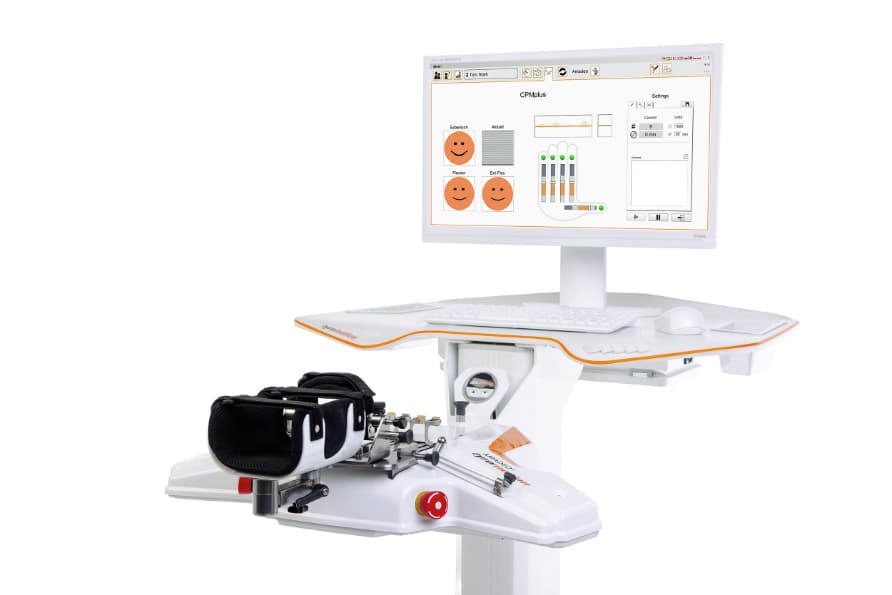
£45,000 – £85,000
Hocoma ArmeoPower
Hocoma ArmeoPower is Hocoma's flagship exoskeleton that combines high-torque actuation, adaptive assistance algorithms and an integrated virtual therapy ecosystem backed by extensive clinical research. It offers the same technical strengths as Armeo Power while emphasizing Hocoma's proprietary software and clinician workflow tools, which can justify a premium purchase price through documented outcome improvements and strong global service and training support. Against lower-cost or newer entrants like InMotion and Fourier, Hocoma positions ArmeoPower as a turnkey, evidence-driven solution for clinics where long-term outcomes and support are prioritized over minimal initial expenditure.

£100,000 – £160,000
Fourier Intelligence ArmMotus M2
Fourier Intelligence's ArmMotus M2 is a modular upper-limb rehabilitation platform that emphasizes configurability (supporting different attachment modes), cloud connectivity and competitive pricing aimed at broad clinical adoption. Its modular architecture and remote data analytics make it attractive to clinics seeking scalable, cost-efficient solutions that can be reconfigured for different patient groups, presenting a lower-entry-cost alternative to established Western brands while offering many comparable therapy features. Although its long-term clinical evidence base is still maturing relative to legacy systems like Hocoma and InMotion, ArmMotus M2's flexibility and price-to-feature ratio often present strong financial value for multi-site deployments.

£60,000 – £110,000
Research and evidence supporting robotic upper limb therapy
A growing body of clinical research supports the use of robotic devices as a component of upper limb rehabilitation. Studies and systematic reviews show that when robotic therapy is added to conventional physiotherapy it can increase the amount of practice patients receive, improve arm function and accelerate recovery in both the subacute and chronic phases after stroke. The technology promotes repetitive, task-specific movements that support neuroplasticity and measurable gains in motor skills. Results are strongest when robotic sessions are frequent, guided by trained therapists, and combined with functional practice.
Systematic reviews and meta-analyses report moderate improvements in upper limb motor scores and activities of daily living when robotics are used alongside conventional therapy.
Randomized controlled trials show that high-dose, repetitive training with robotic assistance can enhance reach, strength and coordination compared with usual care alone.
Robotic systems provide objective outcome metrics and sensitive measures of progress, enabling data-driven adjustments to therapy intensity and goals.
Evidence indicates best outcomes for programmes that integrate robotics with therapist-led functional training and patient-specific goal setting.
Ongoing research is exploring combinations of robotics with virtual reality, neuromodulation and telerehabilitation to extend access and effectiveness.
Frequently Asked Questions
Which upper limb robot is best for patients with severe impairments?
The Armeo Power is the ideal choice for patients with moderate to severe impairments because it provides powered exoskeleton support for the shoulder, elbow, and wrist. It features adaptive gravity compensation and high-torque assistance to facilitate intensive training sessions.
Does the InMotion ARM support high-repetition planar reaching tasks?
The InMotion ARM is specifically designed for high-repetition planar reaching tasks, featuring low inertia and high backdrivability for smooth movement. This end-effector robot promotes active patient participation through assist-as-needed control strategies.
How does the Tyromotion Amadeo differ from whole-arm rehabilitation systems?
The Tyromotion Amadeo focuses exclusively on hand and finger rehabilitation, whereas systems like the Armeo Power target the entire arm. It offers individual finger actuation and high-resolution detection to improve fine motor skills and grip strength.
Is the Armeo Power suitable for tracking patient progress objectively?
The Armeo Power is highly effective for tracking progress, as it includes integrated 3D virtual exercises and automated performance metrics. These tools allow clinicians to monitor objective data throughout the patient's recovery journey, earning the system an average rating of 4.3.
Conclusion
In the UK context, upper limb rehabilitation robots offer clinicians and patients efficient, measurable and scalable therapy options. On this page we highlight five leading systems: Armeo Power, InMotion ARM, Tyromotion Amadeo, Hocoma ArmeoPower and Fourier Intelligence ArmMotus M2. Each platform has strengths for different clinical needs, but Hocoma ArmeoPower stands out for many UK clinics because of its mature evidence base, modular design and strong clinical support network. We hope you found what you were looking for; if you want to narrow results by budget, clinical indication, or portability, or expand your search to include accessories and service plans, please refine your search or use the filters to explore further.