Leading Autonomous Material Handlers for UK Manufacturing Facilities in 2025
Published on Saturday, 12 April 2025
The manufacturing sector across the United Kingdom is experiencing a fundamental shift in how materials move through production environments. Autonomous Guided Vehicles (AGVs) have transitioned from being novel technology to becoming standard infrastructure within modern factories, warehouses, and distribution centres. These intelligent robotic systems navigate factory floors with remarkable precision, managing everything from component transport to finished goods handling without requiring dedicated operators. British manufacturers face mounting pressure to optimise productivity whilst maintaining stringent safety standards—a challenge that AGVs address comprehensively. By integrating cutting-edge navigation technology, real-time fleet management, and adaptive routing capabilities, contemporary AGVs deliver measurable improvements in throughput, workplace safety, and operational expense reduction. The competitive landscape of UK manufacturing increasingly demands adoption of such automation solutions to maintain market position and meet customer expectations for rapid, reliable delivery. Whether operating in automotive facilities, pharmaceutical manufacturing, food processing, or general assembly environments, these vehicles represent a pragmatic investment in future-proofing production operations. This guide examines the most capable AGV solutions currently available to British industrial operators, highlighting their distinctive capabilities and practical applications across diverse manufacturing scenarios.
Top Picks Summary
MiR250 Hook
The MiR250 Hook earns its spot for 2025 by combining Mobile Industrial Robots' proven autonomous navigation with a compact hook-tow design ideal for UK assembly lines that require flexible material flow between stations. It is a cost-effective, easy-to-deploy AMR that outperforms larger forklift-style AGVs on agility and integration speed, making it financially attractive for mid-size manufacturers compared with the heavier, higher-capex Linde and Toyota solutions while offering more openness and lower implementation time than some OMRON fleet setups.

OMRON LD-250
The OMRON LD-250 is a market leader for operations needing robust sensor fusion and mature fleet management on complex shop floors, delivering high uptime and predictable performance for UK assembly line automation in 2025. Technically superior in precise navigation and safety features, it typically commands a higher upfront price than lightweight AMRs like the MiR250 but reduces integration risk and downtime costs for facilities that require deterministic multi-robot coordination compared with more manual retrofit AGV options.
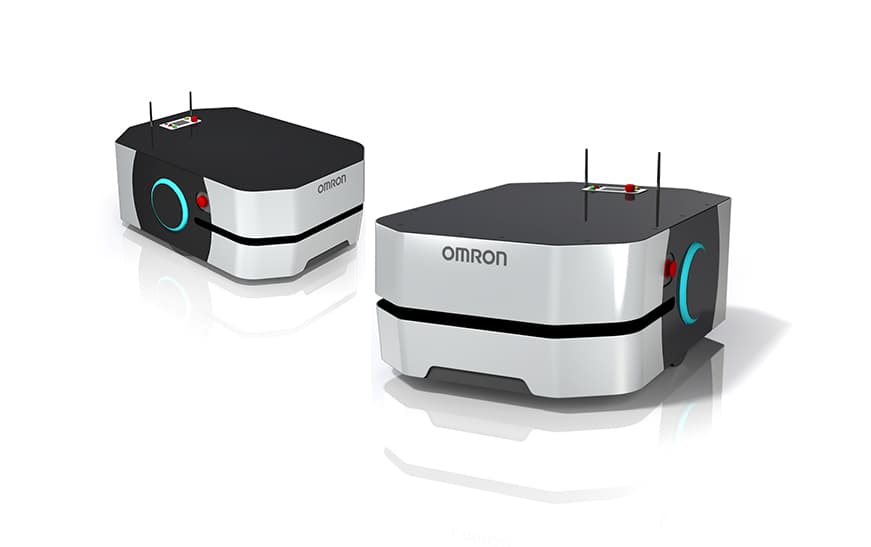
Linde L-MATIC AC
Linde's L-MATIC AC secures its position by offering heavy-duty, industrial-grade AGV performance tailored to assembly lines that move larger pallets or require lift functions, making it the go-to for UK manufacturers with high payload or lift-height needs in 2025. While its capex and footprint are higher than agile AMRs such as MiR and OMRON, the Linde delivers lower lifecycle costs for heavy applications and integrates well into traditional material handling fleets where Jungheinrich and Toyota compete on similar industrial robustness.
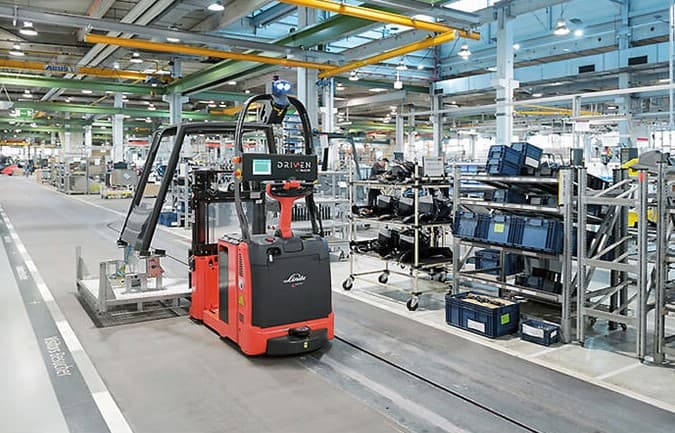
Toyota Autopilot AGV
Toyota Autopilot AGV stands out for its proven reliability and deep vertical expertise in automotive and assembly environments, offering scalable fleet solutions and extensive UK service support that translate to attractive total cost of ownership in 2025. Its strength is operational resilience and long-term durability for high-utilisation sites, positioning it as a stronger choice than lighter AMRs for OEMs while providing comparable industrial-grade performance to Linde and Jungheinrich with Toyota's global support network as a financial and logistical advantage.

Jungheinrich EKS 215a
The Jungheinrich EKS 215a is selected for its energy-efficient electric architecture and compact counterbalanced design that fits tight assembly-line footprints common in UK plants in 2025, offering an economical balance between payload capacity and operating cost. It often undercuts the heavier Linde or Toyota systems on purchase price and running costs for medium-duty tasks, while providing more capacity than small AMRs like the MiR250, though it is less flexible for dynamic reconfiguration than OMRON-style fleet systems.
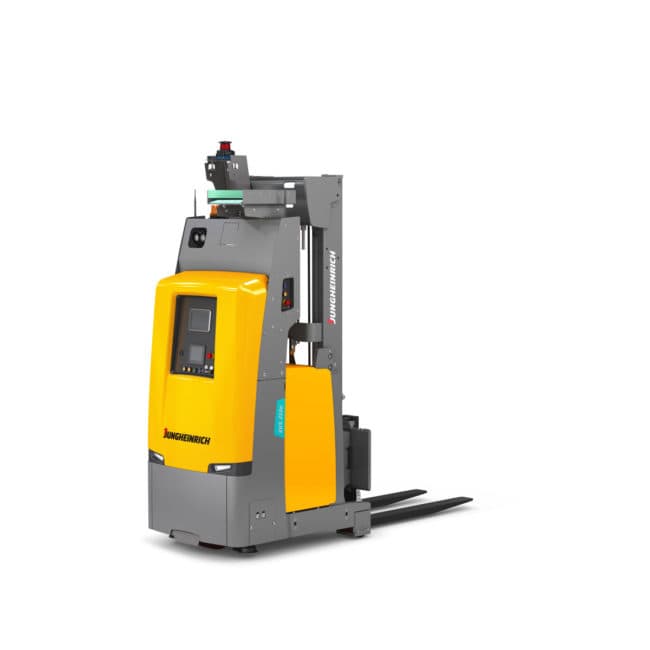
These leading AGV platforms distinguish themselves through advanced obstacle detection, seamless warehouse management system integration, impressive load capacity ranges, extended operational autonomy, and UK-based technical support infrastructure. They collectively represent the pinnacle of current automated material handling technology available to British manufacturers.
Understanding Modern Autonomous Guided Vehicles for Manufacturing
Autonomous Guided Vehicles have evolved significantly from their early iterations. Contemporary AGV systems utilise sophisticated sensor arrays, artificial intelligence-driven navigation algorithms, and cloud-based fleet management platforms to operate safely and efficiently within complex manufacturing environments. Understanding the key technological components and operational considerations helps manufacturers make informed decisions.
Advanced LIDAR and vision-based navigation systems enable real-time obstacle avoidance and dynamic route optimisation
Integrated fleet management software provides centralised monitoring, analytics, and performance reporting across multiple vehicles
Modular design approaches allow customisation of payload attachments and configurations for specific manufacturing tasks
Battery technology advancements deliver extended shift operations, reducing downtime and charging requirements
Safety-first architecture includes emergency stop protocols, collision prevention systems, and worker presence detection
Scalability features enable gradual fleet expansion aligned with production growth and changing operational needs
Integration capabilities with existing Manufacturing Execution Systems and warehouse management platforms streamline data flow
Remote diagnostics and predictive maintenance reduce unexpected downtime and optimise total cost of ownership
Frequently Asked Questions
Which AMR should I choose for UK assembly lines?
For flexible pick-and-carry between stations, the MiR250 Hook is a strong fit because it has a 250 kg payload capacity with a hook attachment, earns a 4.4 average rating, and is described as a cost-effective, easy-to-deploy AMR.
Does the OMRON LD-250 use SLAM for navigation?
Yes—the OMRON LD-250 lists 250 kg payload support with reliable line-of-sight and SLAM navigation for dynamic routes, and it includes built-in fleet management plus comprehensive safety with 360° scanners and emergency stop systems.
How does the MiR250 Hook price compare to alternatives?
The provided data doesn’t include prices for the MiR250 Hook, OMRON LD-250, or Linde L-MATIC AC, so I can’t compare value by cost from these product details.
Is the Linde L-MATIC AC suitable for pallet transport?
Yes—the Linde L-MATIC AC is designed for robust towing and pallet transport, with industrial-grade traction and AC drive technology for energy-efficient continuous operation, and it has an average rating of 4.4.
Conclusion
The transition to autonomous material handling represents a strategic investment rather than merely a technological upgrade for UK-based manufacturers. The solutions examined here have demonstrated tangible performance improvements across multiple industry sectors, from streamlined production workflows to enhanced worker safety metrics. Selecting the appropriate AGV system requires careful consideration of your specific operational requirements, facility layout, integration compatibility with existing systems, and long-term scalability needs. Each platform discussed offers distinct advantages depending on your manufacturing context and growth trajectory. We recommend conducting thorough assessments of multiple solutions before making final procurement decisions. Should you require additional technical specifications, pricing information, or guidance on implementation strategies, our detailed product pages provide comprehensive comparisons. Your journey towards operational excellence through automation begins with understanding what each system can deliver to your unique manufacturing environment.