

Top 5 Continuous Blood Pressure Monitors in the UK — 2026 Guide
Continuous blood pressure monitors are changing how people in the UK keep on top of cardiovascular health. Unlike single-point cuffs, continuous monitors capture trends across the day and night, revealing patterns such as nocturnal hypertension or activity-related spikes that routine checks can miss. With rising awareness of high blood pressure and its links to stroke and heart disease, more Brits are looking for reliable monitoring that fits daily life — whether managing a diagnosis, supporting a GP-led care plan, or monitoring the effects of medication and lifestyle changes. For UK users, practical points matter: device accuracy versus ambulatory clinic standards, ease of sharing readings with your GP or cardiologist, data privacy under UK rules, and compatibility with NHS-friendly systems or common smartphones. Some devices prioritise comfortable, all-day wear; others focus on clinical-grade spot checks with fast sync to health apps. Price, battery life, UKCA or CE marking, and local support channels are also important when buying in Britain. Start with the accuracy question, because the marketing in this category runs ahead of the evidence. The British and Irish Hypertension Society updated its position in June 2026: it approves no wearable or cuffless device for routine clinical use, and it points out that a CE mark or a published validation study is not the same thing as BIHS validation. Treat any cuffless number as trend data and confirm anything that matters on a BIHS-listed upper-arm cuff. Availability is the second filter. This round-up compares five devices, and only one of them is a current UK product. The Aktiia 24/7 bracelet was rebranded Hilo in 2025 and is sold from a UK store at £199.98 for the first year; it is the only genuinely passive, cuffless monitor here. Omron's HeartGuide is discontinued, so UK listings are remaining or resale stock at well above its original price. YHE now lists the BP Doctor Pro as a legacy model that is no longer in production. The BodiMetrics device is a wellness ring rather than a blood pressure instrument. The Omron Complete BP7900 is a US-market monitor that UK buyers import. Each is judged below on how it actually measures, what it costs to keep running, and whether you can buy it here.
Inception's AI took the time to understand this market in the UK · We may earn a commission on purchases. It never affects our rankings.
Top Picks Summary
Aktiia 24/7 Blood Pressure Monitor
The Aktiia bracelet, rebranded Hilo in 2025, is the only device on this list that measures without being asked. An optical sensor at the wrist takes readings through the day and night with no inflation, after the upper-arm cuff supplied in the box calibrates it and recalibrates it periodically. Hilo sells it as a system rather than a gadget: £79.99 for the band plus a £119.99 annual membership, £199.98 together in the first year. It is a CE Class IIa medical device validated to ISO 81060-2, but BIHS does not endorse cuffless devices for clinical use, so it earns its place as a trend tool you bring to your GP, not as a replacement for a validated cuff.

Where to buy Aktiia 24/7 Blood Pressure Monitor in UK: we track one retailer, Aktiia, and show the price we last observed there; the price you see at checkout may differ.
We may earn a commission on purchases. It never affects our rankings.
£199.98 GBP first year, then £119.99 GBP a year
Omron HeartGuide
The Omron HeartGuide (HCR-6900T-M) solved the cuffless accuracy problem by refusing to be cuffless: a miniature oscillometric cuff is built into the watch band and inflates when you take a reading, which is why it is FDA-cleared and CE-marked where optical estimates are not. It also tracks activity and sleep. Two things to know before buying. It takes spot readings on demand rather than measuring continuously, and you must hold the wrist at heart level while it inflates. Omron has discontinued it, so UK listings are remaining or resale stock priced above the roughly €549 it launched at in 2019.

Where to buy Omron HeartGuide in UK: we track one retailer, eBay, and show the price we last observed there; the price you see at checkout may differ.
We may earn a commission on purchases. It never affects our rankings.
£500 – £700
YHE BP Doctor Pro
The YHE BP Doctor Pro is not cuffless: a patented inflatable air-cuff in the strap tightens to take an on-demand reading, alongside PPG heart rate, SpO2 and sleep tracking in a companion app. That mechanism is the honest part of its pitch. The rest has aged. YHE now lists the Pro as a legacy model no longer in production, discounted to $199 from $449 on its own shop, and directs buyers to the current BP Doctor Fit, Ultra and Med instead. Prices are quoted in US dollars, so a UK purchase means shipping and import charges, and the device has none of the independent validation the cuff-based monitors here carry.

Where to buy YHE BP Doctor Pro in UK: we track one retailer, Shop, and show the price we last observed there; the price you see at checkout may differ.
We may earn a commission on purchases. It never affects our rankings.
£249 – £299
Bodimetrics CircuTrack
This listing points at BodiMetrics' CIRCUL wellness ring, which the company sells as a sleep, heart-rate and blood-oxygen tracker worn on the finger. Blood pressure is not what it is validated or marketed to do: where the feature appears in the CIRCUL ecosystem it is flagged as a research or wellness function rather than a measurement you should act on, and there is no cuff and no independent validation behind it. Judge it as a comfortable overnight SpO2 and sleep ring, which is a real and useful thing, and take its blood pressure output as an unvalidated estimate.

Where to buy Bodimetrics CircuTrack in UK: we track one retailer, Bodimetrics, and show the price we last observed there; the price you see at checkout may differ.
We may earn a commission on purchases. It never affects our rankings.
£149 – £249
Omron Complete Wireless Upper Arm Blood Pressure Monitor
The Omron Complete BP7900 is the reference for accuracy on this list: a clinically validated upper-arm cuff with a single-lead EKG built in, developed with AliveCor, so one sitting gives you both a blood pressure reading and an AFib check. It is the form factor GPs trust and the one UK guidance points to for confirming a diagnosis. The catch is the market. Omron sells the BP7900 through its US site and its retailers are American; it is not part of Omron's UK range, so buying one here means importing it and living without local warranty support. It also takes readings on demand rather than continuously.
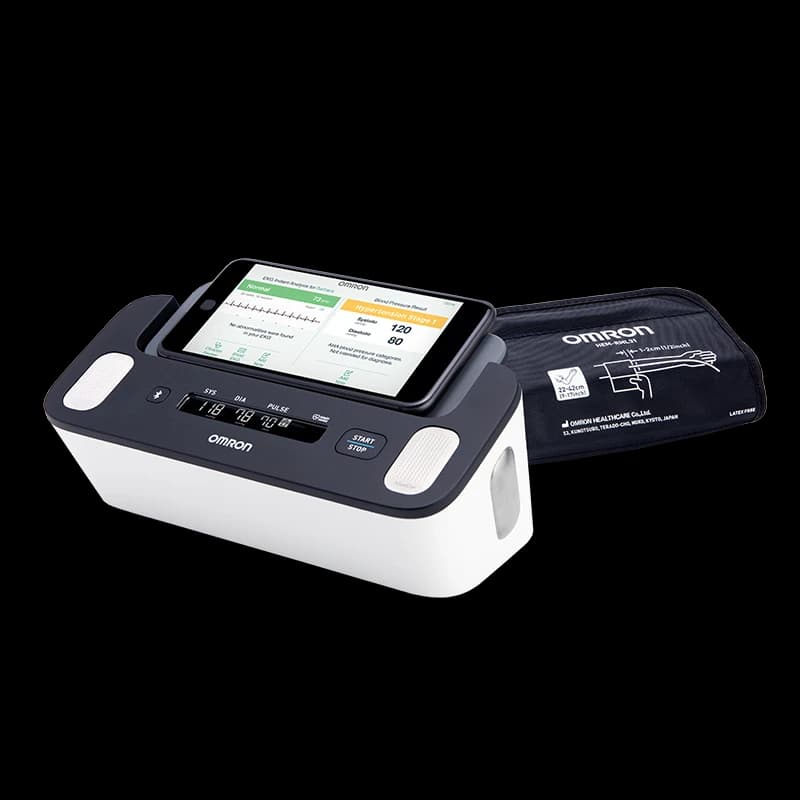
Where to buy Omron Complete Wireless Upper Arm Blood Pressure Monitor in UK: we track one retailer, Omronhealthcare, and show the price we last observed there; the price you see at checkout may differ.
We may earn a commission on purchases. It never affects our rankings.
£129 – £229
Top continuous monitors combine frequent automated readings, comfortable wear or compact cuffs, secure app syncing, exportable reports for clinicians, long battery life and UK regulatory compliance — making them ideal for home management and remote care.
Understanding Continuous Blood Pressure Monitors
Continuous monitoring is genuinely useful for spotting patterns a clinic check misses. It is also the part of the market where claims run furthest ahead of evidence. Here is what to hold on to:
No cuffless wearable is on the BIHS validated list. In June 2026 the society confirmed it is not approving wearable or cuffless devices for routine clinical use.
A CE or UKCA mark means a device may legally be sold, not that it has passed independent accuracy validation. Marketing routinely blurs the two.
Cuffless still means a cuff somewhere: the Hilo band calibrates against an upper-arm cuff supplied in the box, and needs recalibrating periodically.
Overnight readings are the strongest argument for continuous monitoring, because nocturnal hypertension is invisible to daytime spot checks.
UK practice confirms a hypertension diagnosis with ambulatory or home monitoring on a validated cuff, not with wearable estimates.
Check the running cost, not just the purchase price. The Hilo system is £79.99 for the band plus a £119.99 annual membership, bundled at £199.98 in the first year.
Frequently Asked Questions
Which continuous BP monitor should I buy for daily wear?
The Aktiia 24/7 bracelet, now sold as Hilo, is the only one here that measures on its own. Its optical sensor takes readings through the day and night with no inflation, after the upper-arm cuff in the box calibrates it. It runs up to 15 days per charge, is IP68 rated and is a CE Class IIa medical device validated to ISO 81060-2. In the UK it costs £79.99 for the band plus a £119.99 annual membership, bundled at £199.98 for the first year.
Does the Omron HeartGuide include FDA-cleared blood pressure accuracy?
Yes. HeartGuide (HCR-6900T-M) is FDA-cleared and CE-marked, and it works by inflating a miniature oscillometric cuff inside the watch band, so the reading comes from a real cuff rather than an estimate. You must hold the wrist at heart level while it inflates. It does not include ECG, and Omron has discontinued it, so UK listings are remaining or resale stock priced above its original launch price of roughly €549.
Is the YHE BP Doctor Pro still worth buying?
Only if you find it cheaply. It is not cuffless: a patented inflatable air-cuff in the strap tightens to take an on-demand reading. Prices are in US dollars, so UK buyers should add shipping and import charges.
Is Aktiia 24/7 better than a basic cuff for trends?
For trends, yes: it captures a day-and-night profile that a single cuff snapshot cannot show, including overnight readings. For a diagnosis, no. Cuffless estimates are less validated than cuff readings, and BIHS approves no cuffless device for routine clinical use, so pair it with a BIHS-listed upper-arm cuff and take the app's exported report to your GP rather than the raw numbers.
Conclusion
Choosing a continuous blood pressure monitor in the UK comes down to what you need the numbers for. If you want to see a pattern across the day and night, and to arrive at an appointment with an exported report, the cuffless Hilo band is the only device here built for that, subscription and all. If you need a number you and your GP can act on, buy a cuff from the BIHS validated list and check the UKCA or CE marking before you pay.
The two are not in competition. The sensible setup for most people managing a diagnosis is a wearable for trends plus a validated upper-arm cuff for the readings that matter, with the wearable's report used to prompt a conversation rather than to settle one. Ask your GP to review your exported readings, and do not stop or change medication on the strength of an unvalidated estimate.