

Best Medical Mixed Reality Glasses UK 2026: Top 5 for Surgery and Training
None of the headsets on this page is itself a UKCA or CE-marked medical device. They are general-purpose enterprise and industrial mixed-reality headsets that hospitals, universities and simulation centres buy as display hardware, and it is the clinical software running on them — surgical navigation, imaging overlay or tele-mentoring applications from third-party vendors — that carries the medical-device certification and the regulatory responsibility. Read this page as a hardware buying guide for healthcare environments, not as a guide to certified clinical instruments: no device here is approved on its own for diagnosis, surgical guidance or any intraoperative decision, and the headset must never be treated as the regulated part of the system. Buyers should also note that the category is contracting rather than expanding. Microsoft ended HoloLens 2 production in October 2024 with no successor and will stop issuing software updates after 31 December 2027, which changes the calculus for any new NHS or private-hospital deployment. Practical selection criteria are therefore procurement realities — remaining supported lifetime, infection-control and cleaning workflows, whether the device can be worn with PPE and loupes, information-governance sign-off for cameras in clinical areas, and above all whether the specific certified clinical application a trust intends to use actually supports the headset.
Inception's AI took the time to understand this market in the UK · We may earn a commission on purchases. It never affects our rankings.
Top Picks Summary
Microsoft HoloLens 2
HoloLens 2 is the headset the majority of published healthcare mixed-reality applications and pilots were built for, thanks to its binocular see-through optics, hand and eye tracking, spatial mapping and Azure-backed enterprise services. It is not a medical device: any clinical claim belongs to the certified third-party software running on it. Critically for a 2026 buyer, Microsoft ended production in October 2024 with no successor, and software support ends on 31 December 2027, so while it remains the reference platform for existing deployments and for compatibility with established clinical applications, it should not be the basis of a new long-term rollout.

Magic Leap 2
Magic Leap 2 is the most credible currently-supported binocular mixed-reality headset for healthcare settings, offering high-contrast optics with segmented dimming, a wide field of view and a weight distribution clinicians tolerate better over long sessions. It is enterprise hardware, not a certified medical device, and clinical use depends on regulated third-party applications naming it as supported. Its software ecosystem is smaller than the one that grew up around HoloLens 2, which in practice is the main constraint on migrating existing clinical workflows to it.

Where to buy Magic Leap 2 in UK: we track one retailer, Magicleap, and show the price we last observed there; the price you see at checkout may differ.
We may earn a commission on purchases. It never affects our rankings.
£2,500 – £4,000
Vuzix M400
The Vuzix M400 is a monocular assisted-reality device rather than a mixed-reality headset: it places a small flat display to one side of the wearer's vision and pairs it with a high-quality camera. That makes it well suited to tele-consultation, remote assistance and hands-free reference, and it is light, rugged and comparatively inexpensive. It cannot register 3D content to a patient's anatomy and therefore does not serve surgical overlay or spatial planning use cases, and like the rest of this list it carries no medical-device certification of its own.
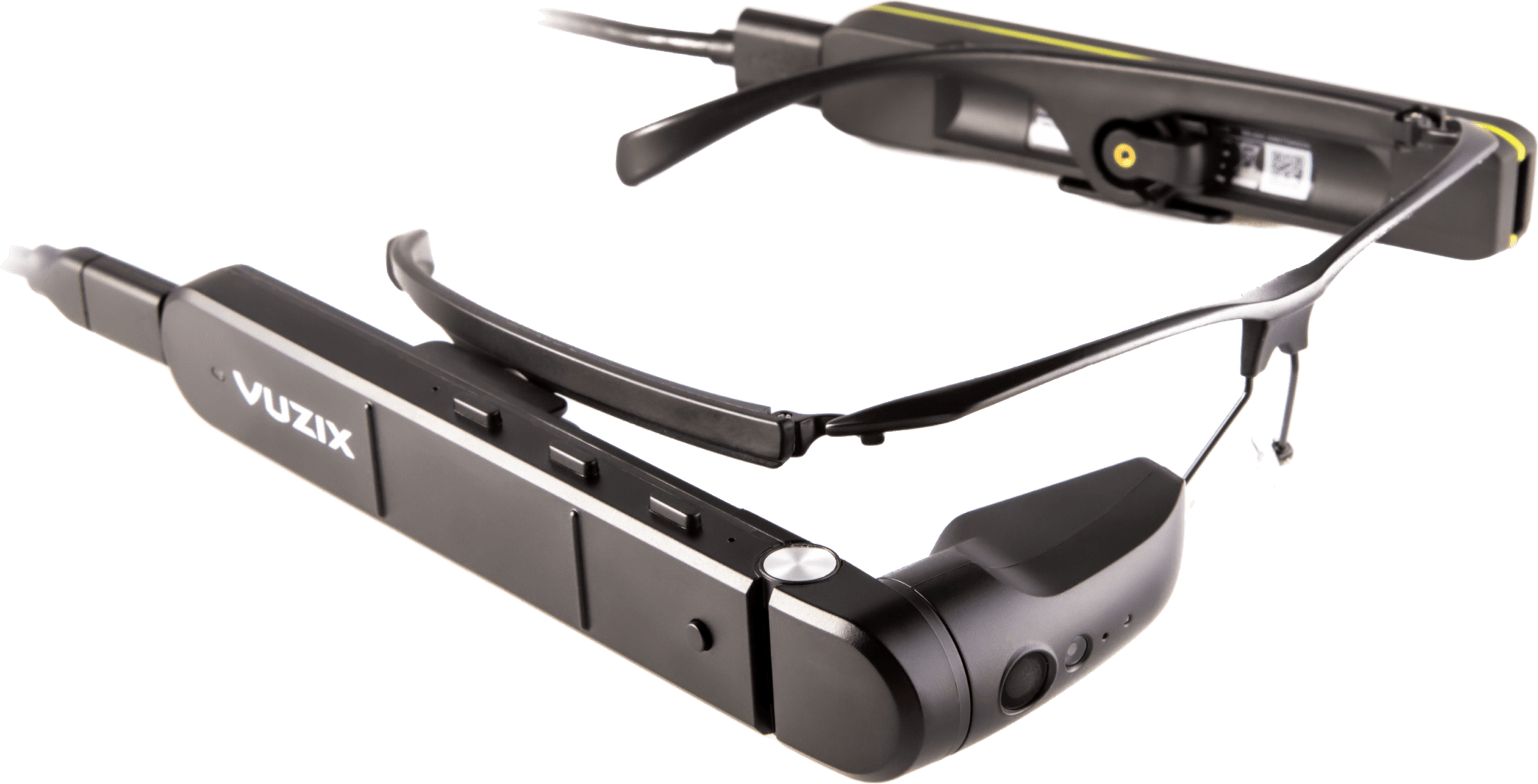
Where to buy Vuzix M400 in UK: we track one retailer, Vuzix, and show the price we last observed there; the price you see at checkout may differ.
We may earn a commission on purchases. It never affects our rankings.
£1,000 – £1,800
RealWear Navigator 500
RealWear Navigator 500 is a voice-driven monocular assisted-reality device designed for noisy, hands-busy industrial environments, and that design transfers well to clinical settings where hands are gloved, sterile or occupied. Its speech recognition works without touch input of any kind, and it is built for durability and long shifts. It offers no spatial mixed reality, no anatomical registration and no medical-device certification, so it belongs in remote-guidance, documentation and procedural-checklist workflows rather than anything intraoperative.

Where to buy RealWear Navigator 500 in UK: we track one retailer, Radioholland, and show the price we last observed there; the price you see at checkout may differ.
We may earn a commission on purchases. It never affects our rankings.
£900 – £1,600
ThirdEye Gen X2
ThirdEye Gen X2 is a binocular mixed-reality headset from a small US vendor that markets directly at healthcare training, telehealth and documentation workflows, offering see-through optics and integrated cameras at a lower price than the major platform vendors. The trade-off is company scale: support, developer ecosystem, long-term supply and clinical-application compatibility are all narrower than for Microsoft or Magic Leap, and it holds no medical-device certification. Independent evaluation of it in UK clinical settings is sparse compared with the other devices here.

Where to buy ThirdEye Gen X2 in UK: we track one retailer, Jonathanthaidesign, and show the price we last observed there; the price you see at checkout may differ.
We may earn a commission on purchases. It never affects our rankings.
£2,000 – £3,500
Research and Evidence: What Studies Say About Mixed Reality in Healthcare
A growing body of clinical research, pilot projects and simulation studies examines mixed reality in medical education, surgical planning and remote guidance. This literature almost always evaluates a specific software application running on general-purpose hardware, not the headset itself, so positive findings for one system do not transfer to another device or to an uncertified workflow. Research typically measures task accuracy, procedure time, cognitive load, training retention and tele-mentoring effectiveness, and results are broadly encouraging in training and planning contexts while remaining more cautious about intraoperative guidance. When evaluating evidence, look for peer-reviewed trials, results from real clinical settings rather than lab demonstrations, patient-relevant outcomes rather than user satisfaction alone, and an explicit statement of which device and which regulated software version was studied.
Studies of surgical planning and navigation applications report improved spatial understanding and decision making in complex cases, but the regulated component is the navigation software, not the headset it is displayed on.
Simulation and training research indicates faster skill acquisition and better retention with mixed-reality overlays than with traditional 2D materials, and this is the use case with the strongest and least regulatory-sensitive evidence base.
Tele-mentoring pilots show that live annotation and video improve remote specialist guidance and can reduce patient transfers; monocular assisted-reality devices perform well here despite offering no true mixed reality.
User studies report reduced cognitive load and fewer workflow interruptions when contextual patient data and hands-free controls are available, though findings depend heavily on the specific application design.
Clinical evaluations consistently stress ergonomics, cleaning and sterility workflows, information governance for head-mounted cameras, and integration with imaging and electronic health records as the factors that determine whether any real-world benefit is realised.
Frequently Asked Questions
Are medical mixed reality glasses regulated medical devices in the UK?
The headsets themselves generally are not. Devices such as HoloLens 2, Magic Leap 2, Vuzix M400 and RealWear Navigator 500 are general-purpose enterprise hardware without UKCA or CE medical-device marking. Certification attaches to the clinical software that runs on them, and that software's manufacturer defines which headsets are supported and for what intended use.
Is the Microsoft HoloLens 2 still a sensible purchase for a UK hospital in 2026?
For a new multi-year deployment, generally no. Microsoft ended HoloLens 2 production in October 2024 with no announced successor, and software updates stop after 31 December 2027. It remains the platform most existing clinical mixed-reality applications were written for, so it still appears in established estates, but new procurement should account for the end-of-support date.
What is the difference between the mixed reality and assisted reality devices on this page?
Magic Leap 2, HoloLens 2 and ThirdEye Gen X2 use binocular see-through optics that place 3D content in the wearer's space, which is what enables anatomical overlay and spatial planning. Vuzix M400 and RealWear Navigator 500 are monocular assisted-reality devices: they show a flat screen off to one side for video, checklists and remote guidance, and cannot register 3D content to anatomy.
Which type of device suits hands-free use in sterile or PPE-heavy clinical settings?
RealWear Navigator 500 is built around voice-only control and noise-robust speech recognition, which works well where hands are gloved or sterile, though it offers no spatial AR. Whichever device is chosen, cleaning and infection-control procedures, PPE and loupe compatibility, and information-governance approval for head-mounted cameras should be confirmed with the trust before deployment.
Conclusion
The honest 2026 summary for the UK is that this is a shrinking hardware category being bought for a growing set of clinical software use cases. Microsoft HoloLens 2, Magic Leap 2, Vuzix M400, RealWear Navigator 500 and ThirdEye Gen X2 are the devices most often encountered in UK healthcare settings, but they are not interchangeable and they are not certified clinical instruments. HoloLens 2 has the deepest healthcare software ecosystem and the largest body of published pilots, yet it is discontinued and out of software support from 2028, so it is now a poor choice for a fresh multi-year deployment and is best understood as the platform most existing UK clinical applications were written for. Magic Leap 2 is the realistic successor for binocular see-through work such as anatomical overlay and planning. Vuzix M400 and RealWear Navigator 500 are monocular assisted-reality devices rather than mixed reality at all; they suit tele-mentoring, remote consultation and hands-free checklists, and RealWear's voice-only control is genuinely useful where hands are gloved or sterile. ThirdEye Gen X2 markets binocular optics and healthcare workflows at a lower price than the platform vendors, from a much smaller company with correspondingly smaller support and ecosystem risk. In every case the decision should start from the certified clinical application and its supported-hardware list, then work back to the headset — never the other way round.