

Deck Lighting for UK Gardens: Five Solar and Low-Voltage Systems Compared on IP Rating, Voltage and Installation
Short answer: for anything recessed into the deck surface, buy IP67 and a 12V SELV (low-voltage) kit you can plug in yourself; keep IP65 for surface-mounted riser, post-cap and wall lights; and treat solar as ambience rather than safety lighting, because a UK December gives roughly eight hours of largely overcast daylight and runtimes collapse accordingly. Anything running at 230V outdoors is a different matter: a new outdoor circuit is notifiable work under Part P of the Building Regulations in England and Wales, so it belongs to a competent-person-registered electrician. With that settled, the rest is a question of layout and taste. Deck lighting has two jobs — stopping people misjudging a step in the dark, and making the space usable after sunset — and the two want different fittings. Edge and stair markers want a low, glare-free output aimed downwards; entertaining areas want warm, wider pools of light at 2700K to 3000K. UK conditions add their own constraints: standing water on horizontal surfaces, freeze-thaw cycles, and salt air on coastal properties, all of which punish poorly sealed fittings and cheap fixings far faster than the manufacturer's stated lifespan suggests. This guide looks at five deck lighting systems and is candid about a problem that most round-ups skip: several of the best-known deck light brands are North American, and their UK availability is patchy.
Inception's AI took the time to understand this market in the UK · We may earn a commission on purchases. It never affects our rankings.
Top Picks Summary
Classy Caps Solar Deck Lights
Classy Caps is the budget pick here: self-contained solar post-cap and surface fittings that install without tools, wiring or any notifiable electrical work, at a price that makes lighting a whole deck perimeter realistic. It is a Canadian brand, and that matters for UK buyers — its main retail presence is North American, so UK stock is intermittent and frequently comes through third-party sellers rather than a UK distributor. Against Luceco's wired fittings it gives up consistency of output, and against Sterno Home's Paradise range it gives up decorative finish, but for a budget-sensitive DIYer who wants a warm glow around posts and rails without touching a cable, it is the straightforward choice.

Luceco LED Deck Lights
Luceco is the only genuinely British name in this group — a UK lighting manufacturer based in Telford — and that is the practical argument for it: UK support, UK warranty handling and parts that are actually obtainable here, none of which is guaranteed with imported solar brands. Its recessed deck fittings use a low-profile metal trim and a narrow downward beam, which is what you want on steps and edges. Two caveats before you buy. Luceco's published UK catalogue is built around exterior, bulkhead, festoon and solar ranges rather than a flagship recessed decking line, and Luceco-badged deck lights appear at retail in both low-voltage wired and solar forms, so confirm the voltage, IP rating and cutout diameter on the specific SKU rather than assuming them.

Deck Dots LED Solar Deck Lights
'Deck dots' describes a format rather than a manufacturer: ultra-low-profile solar LEDs that recess flush into timber or composite so nothing protrudes to trip on. Near-identical units are sold under a rotating cast of seller names, which is the single most important thing to know about them — there is no consistent brand quality behind the category, and two multi-packs bought months apart may not match. Used for what they are, they work: cheap, wire-free edge and stair markers that need no transformer and no electrician. Used as a deck's actual lighting, they will disappoint, because output per unit is low by design and winter runtime is short.
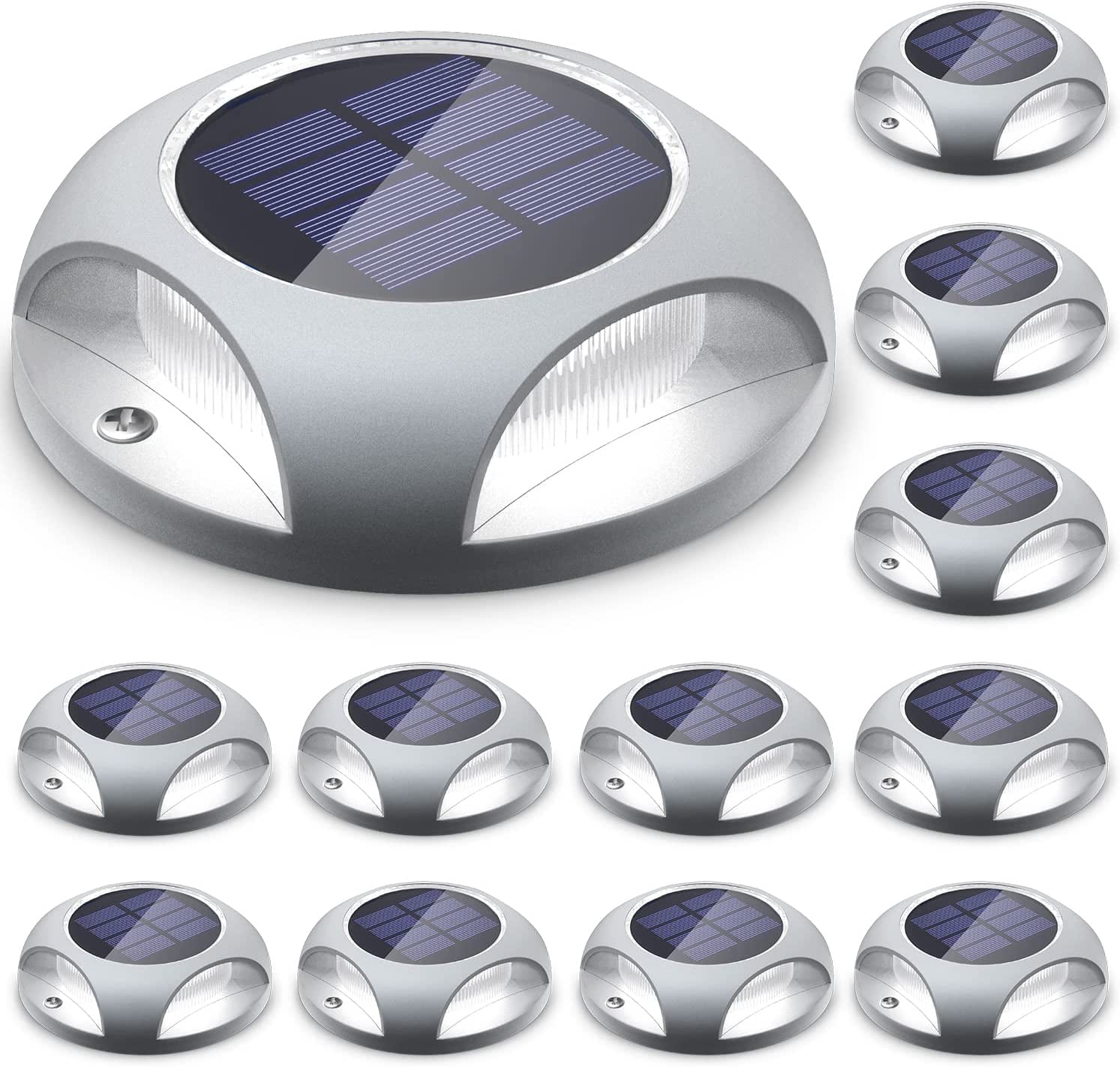
Sterno Home Paradise Solar LED Deck Lights
Paradise, made by the US company Sterno Home, is the decorative choice: cast-finish solar fittings and post caps that look like garden ornaments during the day rather than plastic pucks. It is also the North American brand here most likely to have live UK listings, with individual Paradise solar post lights carried on Amazon's UK site, though the range on offer is a fraction of what is sold in the States. Set expectations on the technology: these are dusk-to-dawn solar fittings with a light sensor and a built-in rechargeable cell, not app-controlled or smart lighting, and reviewers commonly report brightness and battery capacity tailing off after a couple of seasons. You are paying for the finish and the ambience, and on that basis it delivers.

Smartyard LED Solar Deck Lights
SmartYard is a US retail solar lighting line, and it competes on one thing: price per fitting for simple, no-wiring solar deck and step lights. That makes it a reasonable option for covering a lot of deck cheaply where nothing critical depends on the light. UK buyers should go in with their eyes open on two counts. Availability is the bigger issue — this is a US retail brand with no UK distribution, and even US listings for parts of the range show as unavailable, so quantities can be hard to source and repeat. And extended-use reviews consistently cite short runtimes, weak charging in low light and build quality below the premium options, all of which is amplified by a British winter.

These five systems span the realistic options for a UK deck: solar post-cap and surface lights, flush recessed solar 'dots', and low-voltage wired fittings. Each has been assessed on weather sealing appropriate to British rain and freeze-thaw, whether a householder can fit it without notifiable electrical work, and how honestly its output holds up outside midsummer. One caveat worth stating plainly: Classy Caps is Canadian, and Sterno Home's Paradise range and SmartYard are US lines, so UK stock is intermittent and often arrives through third-party sellers — check availability and the plug or transformer supplied before committing to a whole-deck scheme.
Understanding Garden Deck Lighting: Essential Information for UK Homeowners
Three specifications decide whether a deck light survives a British year: ingress protection, voltage, and whether the fixture is rated to be stood or driven on. IP is a two-digit code — the second digit covers water. IP65 means protection against jets of water and is fine for surface, riser and post-cap fittings that shed rain. IP67 means the fitting survives temporary immersion, which is what you actually need for anything recessed flush into a deck or patio where puddles form. Voltage decides who is allowed to install it: 12V SELV kits run from a plug-in transformer and are householder-fitted, whereas 230V mains work outdoors falls under BS 7671 and, in England and Wales, Part P of the Building Regulations. Beyond that, check the cutout diameter before you drill — deck lights are sold by fitting size, not hole size — and check where your joists sit, because a 20mm-deep fitting needs somewhere to go.
IP67 for anything recessed flush into a deck or patio surface, where rainwater pools; IP65 is adequate for surface-mounted riser, step, post-cap and wall fittings that drain freely
'Walkover' and 'drive-over' are separate ratings from IP: a walkover fitting takes foot traffic, a drive-over one is built for vehicle loads on a driveway, and an unrated recessed light is neither
12V SELV kits run from a plug-in transformer and can be fitted by a competent DIYer; a new 230V outdoor circuit is notifiable under Part P in England and Wales and should be installed by a registered electrician or notified to building control (Scotland works to Building Standards, Northern Ireland to its own regulations)
Check the cutout, not the fitting: UK kits commonly pair a 30mm fitting with a 22mm hole, or a 55mm face with a 42mm cutout, and typically need around 20mm of depth clear of joists
Recessed deck dots are markers, not floodlights — most sit somewhere between roughly 10 and 80 lumens each, so plan for several rather than expecting one to light an area
Colour temperature changes the mood more than brightness does: 2700K to 3000K reads warm and domestic, while 4000K and above looks clinical against timber and composite decking
Solar output tracks UK daylight, not the box copy: a unit that runs all evening in June commonly manages an hour or two in midwinter, and a panel in shade or under leaf fall may not charge at all — never rely on solar for step-edge safety lighting
Corrosion-resistant materials such as 304 or 316 stainless steel and marine-grade fixings earn their cost on coastal and high-moisture sites, where cheaper fittings fail at the gasket and screw first
Frequently Asked Questions
Which garden deck lights are best for budget-conscious UK buyers?
Solar post-cap and surface fittings are the cheapest way in, because there is no transformer, no cable run and no electrician. Classy Caps and SmartYard both sit at that end of the market. Be aware that both are North American lines — Classy Caps is Canadian, SmartYard is a US retail brand — so UK stock comes and goes and often arrives via third-party sellers. If you need a specific quantity to finish a deck in one go, check availability before you plan the layout.
What is the main benefit of the Luceco LED Deck Lights design?
The appeal is the low-profile recessed format with a metal trim, which sits flush and throws a narrow downward beam onto steps and edges rather than into people's eyes. Luceco is a UK lighting manufacturer, which makes spares and warranty support easier than with imported brands. One thing to check: Luceco's own UK catalogue is built around exterior, bulkhead, festoon and solar ranges rather than a headline recessed decking line, and retail listings appear in both low-voltage and solar forms — so confirm the voltage, IP rating and cutout size on the specific SKU before ordering.
Are Deck Dots LED Solar Deck Lights suitable for large decking areas?
They are, in the sense that they are sold in multi-packs and need no wiring or transformer, which makes covering a large area cheap. But 'deck dots' is a descriptor rather than a manufacturer — near-identical units appear under many seller names — so build quality and runtime vary between packs, and buyers regularly report uneven brightness across a single order. Treat them as edge markers for a large deck, not as its lighting.
Do Classy Caps Solar Deck Lights require professional installation?
No. They are self-contained solar fittings with adhesive or screw mounting, there is no mains connection, and so no Part P notification or electrician is involved. On decking, prefer the screw fixing: adhesive pads struggle on damp or previously oiled timber. Professional involvement only becomes relevant if you move to 230V mains fittings.
Conclusion
Deck lighting does not need to be complicated, but it does need to be matched to how the deck is used. Solar post-cap and surface fittings, of the sort Classy Caps and SmartYard make, are the quickest route to atmosphere with no wiring at all, provided you accept that their winter performance is a fraction of their summer performance. Flush recessed 'deck dot' lights suit renovators who want markers rather than illumination, and their tool-free adhesive mounting is also their weak point — reviewers routinely report adhesive failures on damp timber, so screw fixing is worth the extra effort. Luceco is the only genuinely British name here — the company is a UK lighting manufacturer based in Telford — although its published catalogue centres on exterior, bulkhead and festoon ranges rather than a dedicated recessed decking line, and Luceco-badged deck lights turn up at retail in both low-voltage and solar forms, so confirm which one a listing is before buying. Sterno Home's Paradise fittings are the decorative pick, and are the North American brand most likely to have live UK listings. For most UK decks the sensible pattern is a 12V IP67 low-voltage kit on the steps and edges, where reliability matters, with solar reserved for the decorative posts and planters where an off night costs nothing.