

Best Window Evaporative Coolers for UK Homes in 2026: Energy-Smart Cooling for the British Summer
Published on Thursday, 16 July 2026
An evaporative cooler is not an air conditioner. It cools by drawing air through a wet pad, which drops the air temperature by a few degrees and adds moisture rather than removing it — so it needs dry incoming air and somewhere for the damp air to escape. That single fact decides whether one is worth buying in Britain. At 40% relative humidity or below these units perform at their best; between 40% and 70% the cooling effect is noticeably reduced; above 70% you should expect little to no benefit. British summer air often sits in the middle-to-upper part of that band, so an evaporative cooler here is best understood as a low-energy appliance that takes the edge off a warm room, not as a replacement for refrigerated cooling. Where they genuinely earn their place is running cost and simplicity. A typical unit draws somewhere between 55W and 250W depending on size, against a kilowatt or more for a portable air conditioner, and there is no refrigerant, no exhaust hose and no window kit to wrestle into a sash frame. For a home office, a bedroom you want cooled cheaply overnight, or a conservatory on a dry day, that trade-off can be exactly the right one. One point of honesty about what follows: true window-mounted evaporative coolers — the boxed units that sit in the window opening and pull outside air through the pads — are essentially a North American and Australian product and are barely sold through UK retail. The five coolers compared below are freestanding portable evaporative coolers, which is what British buyers searching for window evaporative cooling realistically end up with. Their tank capacities, power draw and room ratings vary a great deal, so match the unit to the room rather than to the headline claims.
Top Picks Summary
Honeywell CO30XE Evaporative Air Cooler
The Honeywell CO30XE is the largest cooler in this guide and the one to choose when the room is genuinely big. Its 30-litre tank, four fan speeds and oscillating louvres are rated by Honeywell for spaces up to about 320 square feet — roughly 30 square metres — and it draws around 252W on its low setting, which is still a fraction of what a portable air conditioner pulls. It is built as an indoor/outdoor portable unit with a weather-resistant, UV-protected housing, not as a window-mounted cooler, so plan for floor space rather than a window opening. Against the compact Igenix and Duronic units it offers far more tank capacity and reach; the cost is bulk, weight and a higher power draw.
Igenix IG9703 Portable Evaporative Air Cooler
The Igenix IG9703 is the sensible small-room choice and the cheapest unit here to run. It holds 6 litres, draws just 55W, moves up to 300 cubic metres of air per hour and is rated for rooms of around 15 square metres — a home office, a study or a single bedroom. Three fan speeds, oscillation, an LED display, a seven-hour timer, a water gauge, castors and an ice chamber cover the practical basics without inflating the price. It is a freestanding portable cooler on wheels rather than a window unit. It will not cool a large open space, but for its intended room size the running cost is hard to argue with.
Pro Breeze 4-in-1 Evaporative Air Cooler
The Pro Breeze 4-in-1 is the middle ground, aimed at households that would rather buy one appliance than three. It combines cooling, fan and humidifying duties in a single portable unit with a detachable 5.5-litre tank, two ice packs, three fan speeds, automatic oscillation, an LED display, a remote and a seven-hour timer. Pro Breeze sells the 4-in-1 in several tank sizes, so check the capacity on the listing before ordering. Like the rest of this guide it is a freestanding cooler rather than a window-mounted one, and its cooling still depends on dry incoming air and an open window.
£80 – £140
Mylek Premium Evaporative Air Cooler
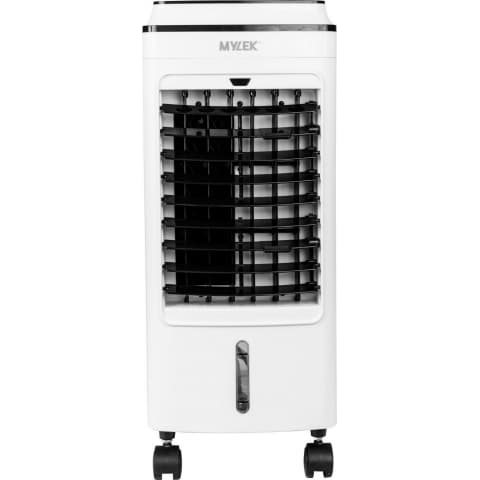
The Mylek Premium is pitched at buyers who want a tidier-looking cooler with digital controls, a remote, timer settings and oscillation rather than the bare-bones budget layout. It is a freestanding portable evaporative cooler, not a window-mounted unit, so the practical considerations are floor space and a nearby socket rather than a window fitting. Published specifications for the UK range vary between the push-button and LED-display versions, so confirm the tank capacity and power rating on the specific listing before ordering, and size it to your room.
Duronic ECO8 Evaporative Air Cooler
The Duronic ECO8 is presented as a compact, low-consumption cooler for small to medium UK rooms, aimed at renters and at anyone wanting an inexpensive secondary unit. We were not able to verify its published tank capacity, airflow or power rating against Duronic's own product listings, so treat the performance claims with caution and check the specification on the retailer's page before buying. As a portable evaporative cooler rather than a window-mounted one, it is subject to the same limits as the rest of this guide: it needs dry incoming air and an open window to do anything useful.
£120 – £200
The appeal here is running cost and simplicity. Power draw ranges from about 55W on a compact 6-litre unit to roughly 250W on a 30-litre one, against a kilowatt or more for a portable air conditioner, with no refrigerant, no exhaust hose and no window kit to fit. Upkeep amounts to topping up the water and rinsing the pads and filter now and then. The trade-off is that these coolers add humidity and need an open window, so they reward dry days and well-ventilated rooms.
How Evaporative Cooling Actually Works
Evaporative cooling is simple physics with real limits. Here is what governs how well one of these units will perform in a British home:
Water absorbs heat as it evaporates, so air pulled through a wet pad leaves the unit cooler than it arrived. The drier the incoming air, the more water can evaporate and the larger the temperature drop.
Relative humidity is the deciding factor. At 40% RH or below an evaporative cooler works at its best; between 40% and 70% its cooling capacity is noticeably reduced; above 70% you can expect little to no cooling benefit.
These units add moisture to a room rather than removing it — a correctly running system can raise indoor humidity by several percent. That is the opposite of what a refrigerated air conditioner does, and it is why they are nicknamed swamp coolers.
Because of that, you need an open window, door or vent so the moist air can escape. Run one in a sealed room and the air turns muggy while the cooling effect stalls.
Power draw is where they win. UK models range from around 55W on a compact 6-litre unit up to roughly 250W on a large 30-litre one, well below the typical consumption of a portable air conditioner.
There is no refrigerant gas and no exhaust hose, so nothing needs venting or reclaiming at end of life. The pads and filters do need rinsing, though, and standing water is best emptied between uses.
Frequently Asked Questions
Do evaporative coolers actually work in the UK?
Only sometimes, and less reliably than in a dry climate. An evaporative cooler performs at its best at 40% relative humidity or below; between 40% and 70% its cooling capacity is noticeably reduced; above 70% you should expect little to no benefit. British summer air frequently sits in the upper part of that range, so treat one as a low-energy appliance that takes the edge off a warm room rather than as a substitute for air conditioning.
Do I need to keep a window open when using an evaporative cooler?
Yes. These units cool by evaporating water into the air, so they raise indoor humidity rather than lowering it — by several percent in normal use. That moist air needs somewhere to go, so leave a window, door or vent open. Run one in a sealed room and the air will feel muggy while the cooling effect stalls.
Which of these coolers suits a large room or conservatory?
The Honeywell CO30XE. It has a 30-litre water tank, four fan speeds and draws about 252W on its low setting, and Honeywell rates it for spaces up to roughly 320 square feet, or about 30 square metres. It is an indoor/outdoor portable unit rather than a window-mounted one, and it is physically bulky, so allow for the floor space.
Which is the cheapest of these to run in a small room?
The Igenix IG9703. It draws 55W, holds 6 litres, moves up to 300 cubic metres of air per hour and is rated for rooms of around 15 square metres, with three fan speeds, oscillation and a seven-hour timer. At that power draw it costs very little to run for an evening, which is the central argument for evaporative cooling in a British home.
Conclusion
Evaporative cooling suits some British homes and disappoints others, and the difference is mostly the weather on the day. The five units here — the Honeywell CO30XE, the Igenix IG9703, the Pro Breeze 4-in-1, the Mylek Premium and the Duronic ECO8 — span a wide range of size and price. The Honeywell CO30XE is the heavyweight: a 30-litre tank, four fan speeds, around 252W on its low setting, and a manufacturer rating of roughly 320 square feet, or about 30 square metres. It is the one to pick for a conservatory or a large open room, provided you can live with its bulk. At the other end, the Igenix IG9703 is a 6-litre, 55W unit moving up to 300 cubic metres of air per hour and rated for rooms of about 15 square metres, which is enough for a home office or a bedroom and costs very little to run all evening. The Pro Breeze 4-in-1 sits in between with a detachable 5.5-litre tank, ice packs, oscillation and a seven-hour timer, for households that want one appliance covering fan, cooler and humidifier duties. The Mylek Premium and Duronic ECO8 round out the mid-range. Whichever you choose, size it to the room, keep a window open, and judge it as a low-energy comfort appliance rather than as air conditioning.