

Best Soft-Sided Dog Carriers UK 2026 — Vet Visits, Trains & Outbound Cabin Flights
Soft-sided dog carriers are the practical pick for UK owners doing vet runs, train and tube journeys, and short trips in the car: they weigh far less than rigid kennels, fold flat for storage, and ventilate better through mesh panels. Before you spend anything, though, know the rule most buying guides skip. Apart from recognised assistance dogs, pets cannot travel in the aircraft cabin on flights arriving into the UK. DEFRA and APHA rules require them to enter as manifest cargo in an IATA-compliant rigid crate, whatever an airline's own pet policy says and whatever a carrier's packaging claims. A soft carrier is therefore usable in the cabin only on flights leaving the UK, and only with the airlines that permit it — mainly European operators such as Lufthansa, which allows an under-seat bag of 55 x 40 x 23 cm, and Air France and KLM at 46 x 28 x 24 cm, each typically capping the pet plus carrier at 8 kg. There is no universal 'airline approved' certification anywhere in aviation: every airline publishes its own maximum dimensions and weight, and that pair of numbers is the only thing worth checking. For the car, Rule 57 of the Highway Code requires a dog to be suitably restrained, and a soft bag sitting on a seat is not a crash restraint unless that specific model has been crash-tested. Finally, size the bag to the dog rather than to the label: measure nose to the base of the tail for length and floor to shoulder for height, then choose a carrier your dog can stand up and turn around in. The five below are grouped by what each is genuinely good for.
Inception's AI took the time to understand this market in the UK · We may earn a commission on purchases. It never affects our rankings.
Top Picks Summary
Sherpa Original Deluxe Airline-Approved Pet Carrier
The Sherpa Original Deluxe is the most useful carrier here for anyone flying out of the UK with a small dog. Its patented spring-wire frame lets the end panel squash down when a gate agent measures the bag against the under-seat space, which is the practical difference between boarding and being turned away. It costs more than the Pecute or AmazonBasics and is heavier than either, and it earns that only if you actually fly. Note that it cannot be used to bring a pet into the UK: inbound pets travel as manifest cargo in a rigid crate under DEFRA rules.

Where to buy Sherpa Original Deluxe Airline-Approved Pet Carrier in UK: we track one retailer, Sherpapet, and show the price we last observed there; the price you see at checkout may differ.
We may earn a commission on purchases. It never affects our rankings.
£50 – £90
Pecute Airline Approved Soft-Sided Pet Carrier
The Pecute is the value pick: at roughly £30 it carries the fuller feature set of the cheap carriers here, with more mesh area, top and front entry, external pockets and an adjustable shoulder strap. Build quality is a step below the Sherpa and reviewers flag sizing that runs small for stockier dogs, but for vet trips, train journeys and the occasional outbound flight it does the job for a third of the price.
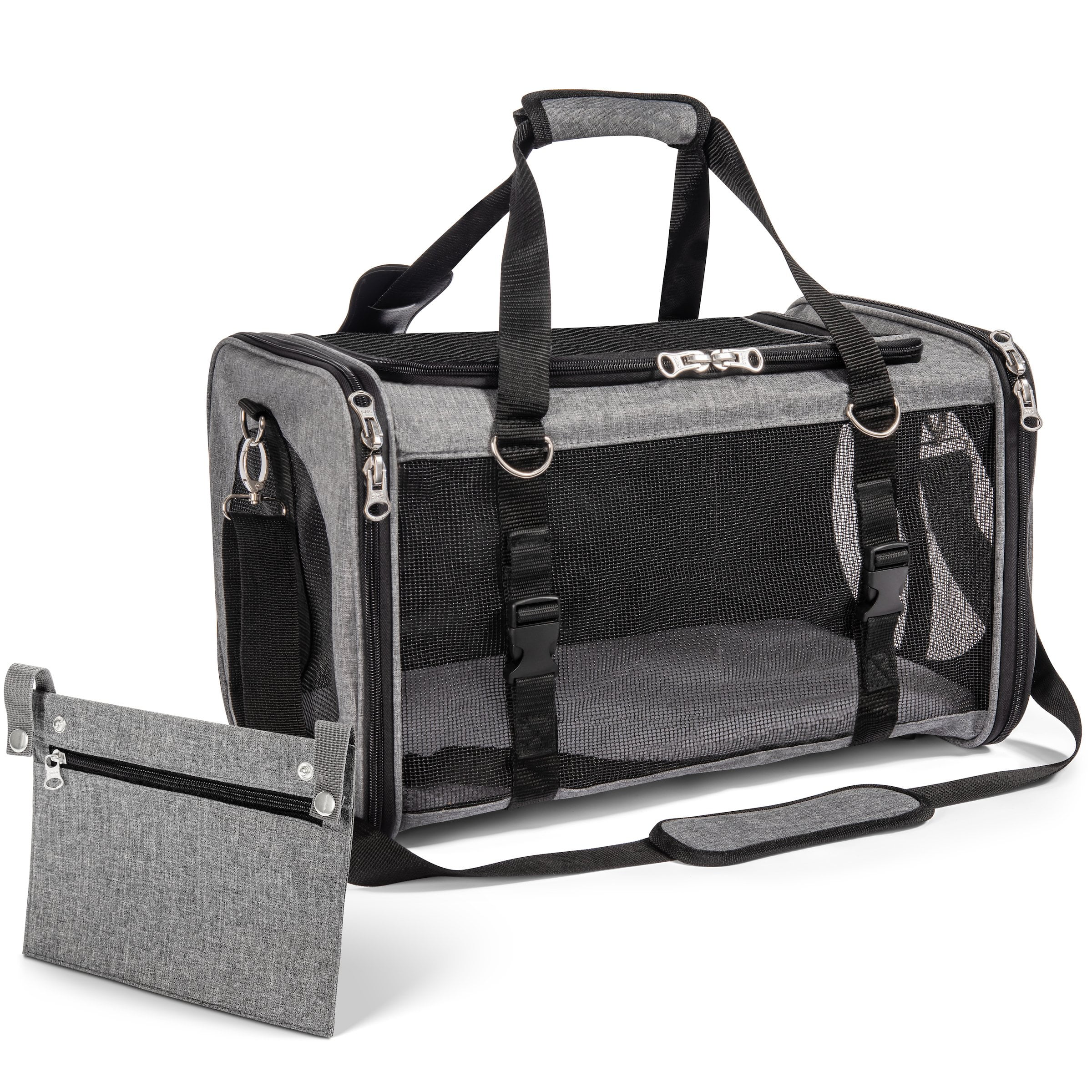
AmazonBasics Soft-Sided Pet Travel Carrier
The AmazonBasics carrier is the plain, dependable staple — a straightforward mesh-and-fabric bag with a rigid base, twin zips and a washable liner, in a broad size range. It has none of the Sherpa's compressible frame and none of the Sleepypod's crash protection, but for vet visits and occasional journeys it is the sensible default, helped by fast UK delivery and easy returns if the size is wrong.

Trixie Alana Soft-Sided Pet Carrier
The Trixie Alana is the cheapest carrier here and suits everyday use — vet runs, a trip to the groomer, a short journey by car or train — where a water-resistant outer, reinforced seams and a padded base matter more than travel paperwork. It is not the bag for flying: long-term reviewers report durability limits under heavy use and tight space for stockier dogs. Trixie is a German brand, but that carries no regulatory weight for cabin travel; no European body certifies pet carriers for aircraft.

Sleepypod Air In-Cabin Pet Carrier
The Sleepypod Air is the only carrier here that does anything real about car safety. It is crash-tested and has integrated seatbelt attachment points, which is what Rule 57 of the Highway Code is actually asking for — the other four are unrestrained bags on a seat. The ballistic-nylon shell and reinforced structure also compress at the ends for under-seat storage on outbound flights. At around £125 it costs roughly four times the Pecute, and it is worth it only if you drive with your dog regularly or fly often.

Where to buy Sleepypod Air In-Cabin Pet Carrier in UK: we track one retailer, Sleepypod, and show the price we last observed there; the price you see at checkout may differ.
We may earn a commission on purchases. It never affects our rankings.
£125 – £200
These five earn their place on weight, ventilation, washable interiors and honest construction rather than on travel claims. Only the Sleepypod Air is crash-tested for car use; none of them carries an 'airline approved' certification, because no such certification exists — cabin acceptance is decided by each airline's own under-seat dimensions and weight cap.
Understanding Soft-Sided Dog Carriers: What British Pet Owners Should Know
Soft carriers are lighter, quieter and easier to store than rigid kennels, and for vet visits, public transport and short car journeys they are the sensible default. Where UK owners get caught out is air travel, where the rules are set by government policy and by individual airlines rather than by anything printed on the bag.
No Cabin Travel Into the UK: except for recognised assistance dogs, pets flying to the UK must arrive as manifest cargo under DEFRA and APHA rules — a soft carrier cannot be used for an inbound flight at all
'Airline Approved' Is Not a Certification: no body issues it. Each airline sets its own under-seat maximum and its own combined pet-plus-carrier weight cap, so check those two numbers on your specific airline's page
Typical Outbound Allowances: Lufthansa permits 55 x 40 x 23 cm under the seat, Air France and KLM 46 x 28 x 24 cm, and both usually cap the pet plus carrier at 8 kg — enough for a small dog only
IATA Rules Govern the Hold, Not the Cabin: IATA's Live Animals Regulations set standards for rigid crates carried as cargo, so a soft bag meeting 'IATA regulations' for the cabin is a claim with nothing behind it
Car Travel and Rule 57: the Highway Code requires dogs to be suitably restrained in a vehicle. A soft carrier on a seat does not qualify unless the model itself has been crash-tested and anchored with the seatbelt as the maker specifies
Measure the Dog, Not the Bag: take length from nose to the base of the tail and height from floor to shoulder, then add a few centimetres so the dog can stand and turn around inside
Train and Tube Travel: UK rail operators generally carry up to two dogs per passenger free of charge, and a carried dog on the Underground avoids the escalator rule that requires small dogs to be carried
Cleaning and Hygiene: most quality carriers use a removable, machine-washable liner, which matters far more in day-to-day use than any travel claim
Ventilation and Weight: multiple mesh panels reduce heat build-up on a warm train or in a waiting room, and a lighter shell means less strain on longer carries
Frequently Asked Questions
Can my dog fly into the UK in the cabin with a soft carrier?
No. Apart from recognised assistance dogs, pets cannot travel in the aircraft cabin on flights arriving into the UK — DEFRA and APHA rules require them to enter as manifest cargo, which means a rigid IATA-compliant crate in the hold. A soft-sided carrier is only usable in the cabin on flights leaving the UK, and only with airlines that permit it.
Which soft-sided carrier is best for flying out of the UK?
The Sherpa Original Deluxe Airline-Approved Pet Carrier, rated 4.6, is the strongest choice: its patented spring-wire frame lets the end panel compress so the bag clears a tight under-seat space, and it has front and top entry plus machine-washable faux-sherpa bedding. Check your airline's own limits first — Lufthansa allows 55 x 40 x 23 cm under the seat, Air France and KLM 46 x 28 x 24 cm, both typically capping pet plus carrier at 8 kg.
Is a soft carrier a legal way to carry my dog in the car?
Rule 57 of the Highway Code requires dogs to be suitably restrained so they cannot distract the driver or injure anyone in a crash. A soft carrier resting on a seat does not meet that unless the specific model has been crash-tested and is anchored as the manufacturer specifies. Of the five here, only the Sleepypod Air In-Cabin Pet Carrier is crash-tested and built with seatbelt attachment points.
Is Pecute cheaper than AmazonBasics, and how do I size a carrier?
They are effectively the same price — the Pecute Airline Approved carrier is about £30.43 against £31.49 for the AmazonBasics Soft-Sided Pet Travel Carrier, so choose on features: the Pecute (4.3) adds top entry, more mesh and pockets, while the AmazonBasics (4.2) offers Amazon's delivery and returns. For sizing, measure your dog from nose to the base of the tail for length and from floor to shoulder for height, add a few centimetres, and make sure the dog can stand up and turn around inside.
Conclusion
Match the carrier to the journey you actually make. The Sherpa Original Deluxe is the best pick if you fly out of the UK with a small dog: its spring-wire frame lets the end panel squash down to clear a tight under-seat space, which is what airline gate checks care about. The Pecute is the value option with the fuller feature set — extra mesh, top entry, pockets — at around £30. The AmazonBasics carrier is the plain, dependable staple for vet trips and occasional journeys, at a similar price with fast UK delivery and easy returns. The Trixie Alana suits everyday vet runs and short trips where a water-resistant outer and a reinforced base matter more than travel paperwork. And the Sleepypod Air is the one to buy if car safety is the real concern, because it is crash-tested and anchors to the seatbelt — the only carrier here that meaningfully addresses Rule 57 of the Highway Code. Whichever you choose, measure your dog first, and if a flight is involved, check your specific airline's published under-seat dimensions and weight cap before you book. Remember that no soft carrier will get a pet into the UK cabin: inbound, it is manifest cargo in a rigid crate.