Top 5 Actinic Bulbs & Tubes for Reef Tanks in the UK — 2026 Expert Guide
Publishing on Friday, 21 August 2026
Actinic bulbs and tubes remain a cornerstone for British reefkeepers who want dramatic coral fluorescence, believable moonlight effects and targeted spectral support. In the UK market, these blue-heavy sources—whether legacy T5/T8 high-output fluorescents or modern LED actinic tiles—are chosen for the way they boost fluorescent pigments in corals and invertebrates, deepen perceived tank colour, and sit alongside full-spectrum lighting to balance growth and appearance. UK hobbyists tend to weigh wavelength peaks (commonly around 420–455 nm), PAR/PUR efficiency, colour rendering, fixture compatibility, lifespan and local availability when deciding between options. For aquarists running T5 HO canopies, the ATI Blue Plus is the premium tube for spectral consistency, while the Aqua Medic Actinic Blue T5 and D-D Ocean Blue T5 offer strong colour pop at more accessible price points. Keepers retrofitting older T8 fittings can drop in the Arcadia Marine Blue Actinic T8, and those moving to energy-saving, controllable LED can step up to the TMC AquaRay Actinic Blue LED Tile. This guide focuses on what matters to UK fishkeepers in 2026—practical compatibility notes, spectral benefits for zooxanthellae-driven corals, and factors like UK shipping and local warranty support. Whether you're refreshing an established T5 setup or adding actinic accents to a modern LED rig, the following five picks cover the common needs and price points seen across UK reefkeeping communities.
Top Picks Summary
ATI Blue Plus T5 Fluorescent Tube
ATI Blue Plus remains a market leader for UK reef keepers thanks to its carefully engineered phosphor blend that balances intense actinic peaks with sufficient mid-blue and white content for natural colour rendition and coral growth. While it comes at a premium compared with budget T5s, its higher sustained PAR, longer tested lifespan and consistent manufacturing make it a technically superior choice versus cheaper tubes like D-D or the T8 options from Arcadia, and a lower-capex alternative for reef keepers not ready to switch fully to LED tiles such as the TMC AquaRay.

Aqua Medic Actinic Blue T5 Tube
Aqua Medic's Actinic Blue T5 is prized in the UK for delivering a strong, narrow actinic spike that produces dramatic fluorescence at a modest price point, making it a go‑to for hobbyists focused on coral colour pop without breaking the bank. Technically it trades a bit of absolute PAR and lifespan for affordability compared with ATI, and it competes well against Arcadia's T8 by offering T5 efficiency and spectrum in a cost‑conscious package — a sensible mid‑range pick for mixed lighting rigs.
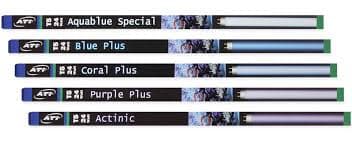
Arcadia Marine Blue Actinic T8 Fluorescent Tube
Arcadia's Marine Blue T8 score as the best value, widely compatible actinic tube for UK aquarists retrofitting older fixtures or running multiple lamps on a budget, providing pleasing blue tones and easy availability through British retailers. Although T8 technology delivers lower PAR and efficiency than the T5 leaders and LED options, Arcadia’s strong local support and dependable colour rendering make it a practical financial choice for large displays or hobbyists prioritising cost and compatibility over top‑end performance.

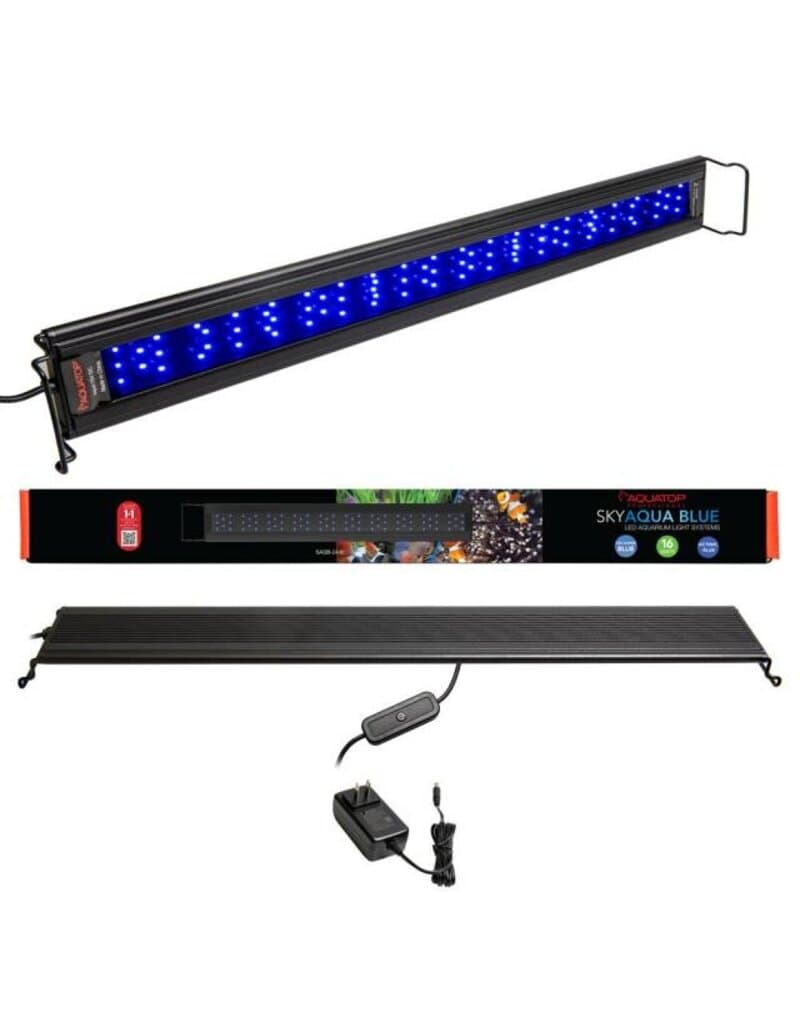
TMC AquaRay Actinic Blue LED Tile
The TMC AquaRay Actinic Blue LED Tile is the energy-efficient choice for UK reef lighting, offering long operational life and precise deep-blue spectral output that can be integrated with controllers for fine-tuned photoperiods. Its higher initial cost is offset by reduced running expenses and flexible mounting compared with tubes, making it the preferred upgrade for aquarists seeking long-term savings and strong PAR-per-watt performance relative to traditional fluorescent options like ATI and Aqua Medic.
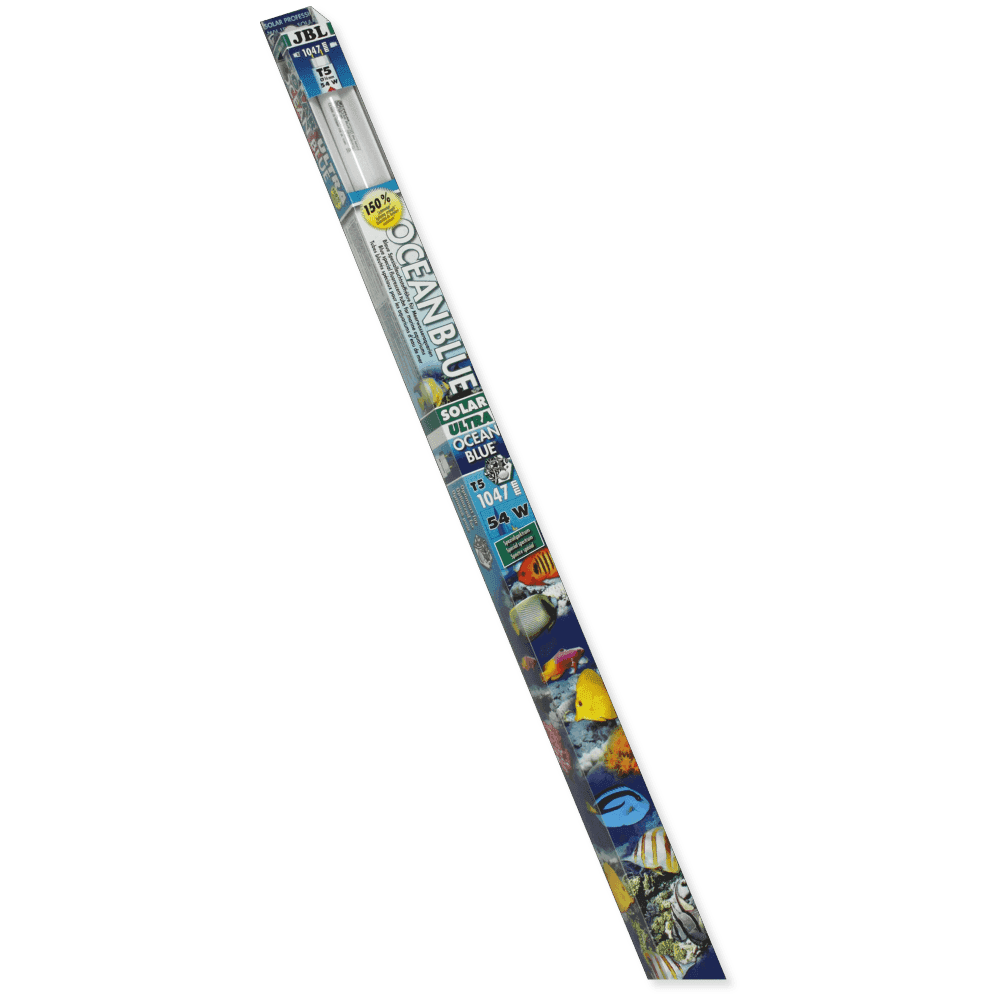
D-D Ocean Blue T5 Tube
D‑D's Ocean Blue T5 is a strong budget‑friendly option in the UK scene that delivers attractive actinic coverage and lively coral fluorescence at a lower purchase price, ideal for multi‑lamp setups where per‑tube cost matters. While it doesn't quite match ATI for spectral refinement or the longevity of LEDs like the AquaRay, its favourable price‑to‑performance ratio makes it a smart, economical choice for hobbyists aiming to boost colour without major capital outlay.
ATI Blue Plus T5: premium fluorescent consistency and deep actinic spectrum for demanding T5 systems. Aqua Medic Actinic Blue T5: best value T5 with strong blue pop. Arcadia Marine Blue Actinic T8: ideal drop-in for legacy T8 fixtures. TMC AquaRay Actinic Blue LED Tile: energy-efficient, controllable LED for modern rigs. D-D Ocean Blue T5: budget-friendly T5 for multi-lamp setups.
What Research and Practical Studies Say About Actinic Blue Lighting
Scientific studies and aquaculture research help explain why actinic (blue) lighting is an important tool for reef hobbyists. Blue wavelengths penetrate seawater effectively and align with absorption peaks of many coral symbionts and fluorescent proteins, which explains both the biological and visual effects hobbyists observe. Below are beginner-friendly takeaways based on peer-reviewed work and industry research.
Blue wavelength relevance: Research shows blue light (roughly 420–470 nm) passes farther through water and strongly excites many coral fluorescent proteins and photopigments, increasing visible fluorescence without necessarily increasing heat load.
Photosynthesis and PUR vs PAR: Studies emphasize that photosynthetically usable radiation (PUR) — not just total PAR — matters for coral symbiont efficiency. Actinic peaks can raise PUR per watt for zooxanthellae that absorb blue light effectively.
Fluorescence benefits: Peer-reviewed observations and controlled aquarium trials report increased fluorescence intensity under actinic-rich spectra, improving visual contrast and colour saturation in reef displays.
LED spectral tuning: Recent aquaculture and industry analyses demonstrate that LED fixtures can be tuned to deliver targeted actinic peaks while maintaining energy efficiency and fixture longevity, often outperforming older fluorescent options on lifetime cost and spectral stability.
Behavioral and circadian impacts: Controlled lighting studies show that lower-intensity blue light used as ‘moonlight’ supports natural nocturnal behavior and spawning cues in some marine organisms when applied appropriately.
Caveat on balance: Scientific literature and hobbyist experiments both caution that actinic lighting should be paired with adequate full-spectrum PAR for many photosynthetic corals; excessive actinic without sufficient broad-spectrum light can limit growth in coral species that require higher PAR.
Frequently Asked Questions
Which actinic tube should I choose for T5 fixtures?
Choose the ATI Blue Plus T5 Fluorescent Tube if you have T5 fittings, because it’s “specifically built for T5 fixtures” and is rated 4.6. It’s designed around deep actinic output in the ~420–460 nm band for coral fluorescence.
What wavelength range does the ATI Blue Plus emphasise?
The ATI Blue Plus T5 Fluorescent Tube emphasises deep actinic output in the ~420–460 nm band, with a phosphor blend aimed at strong actinic peaks. Its average rating is 4.6.
Is the Arcadia Marine Blue T8 tube cheaper than ATI?
Yes. On our 2026 UK pricing the Arcadia Marine Blue Actinic T8 sits at roughly £12–25, while the ATI Blue Plus T5 typically runs about £25–40. The Arcadia is the budget T8 retrofit pick (rated 4.2); you pay more for the ATI (rated 4.6) in return for tighter spectral consistency and longer stable output.
Are these tubes compatible with older fixtures using T8?
Arcadia Marine Blue Actinic T8 Fluorescent Tube is made for the T8 format, so it suits older fixtures that accept T8 actinic tubes. It’s rated 4.2 and is described as easy to source and fit for retrofits.
Conclusion
Actinic lighting in the UK continues to be an effective way to emphasise coral fluorescence, simulate gentle moon phases and provide targeted blue spectrum support without overhauling an entire lighting rig. Among the five models profiled—ATI Blue Plus T5, Aqua Medic Actinic Blue T5, Arcadia Marine Blue Actinic T8, TMC AquaRay Actinic Blue LED Tile and D-D Ocean Blue T5—the ATI Blue Plus stands out as the premium fluorescent for demanding T5 systems that prioritise spectral consistency. If you want strong colour at a lower spend, the Aqua Medic and D-D T5 tubes are sensible value picks; the Arcadia T8 is the practical drop-in for older fixtures; and the TMC AquaRay LED Tile suits keepers wanting energy efficiency and controllable photoperiods. Before you buy, check UK stockists for next-day dispatch, confirm ballast or driver compatibility and tube length, and look for local warranty and returns policies. If you'd like, refine this shortlist by wavelength peak, PAR/PUR output, fixture type or UK price and shipping to find the best match for your aquarium and budget.