

Best Balance Boards & Stability Trainers in the UK 2025 - Expert Guide for Rehabilitation and Fitness
Balance boards have become essential equipment across British physiotherapy clinics, fitness studios, and home gyms, offering a versatile approach to enhancing proprioception, strengthening core muscles, and accelerating recovery from injury. These specialised training tools range from unstable surfaces that challenge your body's stabiliser muscles to dynamic rocker designs that simulate real-world movement patterns. UK consumers are increasingly seeking balance boards that deliver tangible results whether you're recovering from a sports injury, improving athletic performance, or simply maintaining better posture during daily activities. The British market in 2025 reflects a growing demand for equipment that serves multiple purposes: NHS physiotherapists recommend them for post-operative rehabilitation, personal trainers integrate them into functional fitness programming, and healthcare professionals value their effectiveness for fall prevention in older populations. Modern balance boards now feature improved durability, eco-conscious manufacturing, and clear progression guidelines that make them accessible to beginners whilst challenging for advanced users. Whether you're based in London, Manchester, or anywhere across the UK, finding the right balance board means considering factors such as your specific rehabilitation needs, available space at home, weight capacity, and whether you prefer a classic wobble design or a more sophisticated multi-functional trainer that combines stability work with dynamic movement preparation.
Inception's AI took the time to understand this market in the UK · · How we pickWe may earn a commission on purchases. It never affects our rankings.
Top Picks Summary
Yes4All Wooden Wobble Balance Board with Roller
The Yes4All Wooden Wobble Balance Board is a market favorite for classic, budget-friendly instability training, offering sturdy hardwood construction that handles heavier users and freestyle balance practice. Its financial advantage is clear — it’s one of the most affordable durable boards for skill work and skate/surf training simulation — but it is less forgiving than foam pads (Airex, STOTT) and less versatile than modular boards (Revolution) or commercial trainers (BOSU). Technically simple and robust, it’s ideal for athletes who want raw proprioceptive challenge without bells and whistles.

Estimated£27 – £48
EVERYMILE Wobble Balance Board
EVERYMILE's Wobble Balance Board earns its place as the best value pick for rehab and home use thanks to a user-friendly dome design and a surprisingly sturdy build that suits beginners and light clinical use. It undercuts mid‑range competitors on price while still delivering reliable anti‑slip surface and a forgiving wobble, though it sacrifices the hardwood durability and higher weight capacity found in premium boards like the StrongTek. For UK buyers wanting low upfront cost for core stability work or post‑injury balance drills, EVERYMILE offers the most budget‑effective entry without feeling toy‑grade.

Estimated£25 – £40
66fit Wobble Balance Board
66fit's Wobble Balance Board is a strong mid‑range choice tailored to home fitness and rehab clinics that need a durable, well‑balanced platform with good grip and a stable wobble arc. It generally costs more than economy models like EVERYMILE but returns value via higher build quality and consistent performance for physiotherapy and progressive core training; it sits comfortably below the premium StrongTek in price while outperforming cheaper plastics on longevity. Compared to the feature‑focused Opti board, 66fit prioritises solid, simple mechanics that therapists and steady progressors appreciate.

Estimated£30 – £50
Opti Wobble Balance Board
The Opti Wobble Balance Board stands out for its adjustable challenge and coachable progression, offering interchangeable dome sizes or variable wobble settings that make it ideal for targeted core stability work and staged rehab protocols. Its technical flexibility often makes it pricier than the entry level EVERYMILE but more affordable than high‑end wooden pro models, and it strikes a balance between bespoke training features and value—especially useful when clinicians need to tailor difficulty without buying multiple boards. Compared with 66fit, Opti trades some raw simplicity for configurable resistance and a broader training envelope.
Estimated£35 – £60
StrongTek Professional Wooden Balance Board
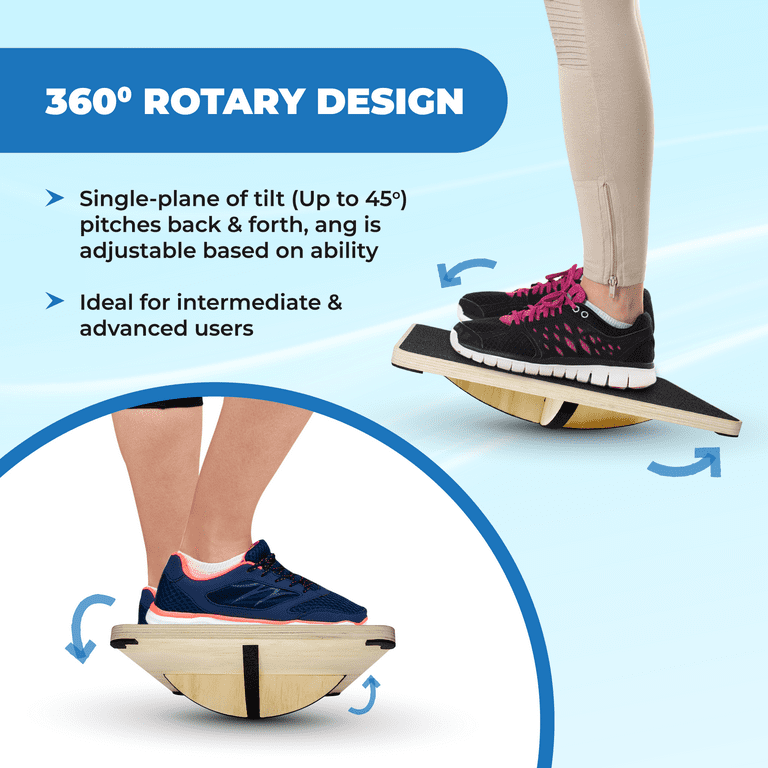
StrongTek's Professional Wooden Balance Board is the market leader for clinics and serious home trainers, built from solid hardwood with a high weight capacity and a premium non‑slip finish that withstands heavy use and delivers consistent proprioceptive feedback. It commands a higher price than the other boards listed, but that investment buys exceptional durability, a natural wobble profile favoured in rehab settings, and longevity that makes it more cost‑effective over years of daily use. Compared to plastic or adjustable models like Opti, StrongTek offers the traditional, high‑performance feel clinicians trust for advanced balance and core stability training.

Estimated£80 – £150
These five balance boards represent the pinnacle of UK market offerings in 2025, distinguished by their clinical validation, long-term durability, thoughtful design features, and proven effectiveness across diverse user demographics. From premium multi-functional trainers to affordable, space-saving options, each product has been selected for delivering measurable improvements in stability, core strength, and functional movement patterns.
What Research Says About Balance Board Benefits
A growing body of clinical trials and systematic reviews supports the use of balance boards to improve postural control, ankle and knee stability, and core muscle activation. Research shows balance training can reduce fall risk in older adults, improve functional outcomes after ankle sprain or ACL rehabilitation when used as part of a progressive program, and increase proprioceptive awareness that transfers to daily tasks and sport-specific movements. Benefits are strongest when training is supervised, progressed safely, and combined with strength and functional exercises.
Balance training reduces fall risk and improves static and dynamic balance in older adults according to several randomized controlled trials and meta-analyses.
Use of unstable surfaces like balance boards increases core and lower limb muscle activation compared with stable surfaces, shown in EMG studies.
Programs that include balance boards after ankle sprain or ACL reconstruction show better proprioception and functional outcomes than standard care alone.
Short, regular sessions (10 to 20 minutes, 3 times per week) produce measurable improvements in postural control for both rehab and fitness users.
Safety and progression matter: supervised or guided progression reduces injury risk and maximizes benefits, particularly for clinical populations.
Frequently Asked Questions
Which wobble balance board suits rehab beginners best?
EVERYMILE Wobble Balance Board is the best value pick for rehab and home use, with a user-friendly dome design and a sturdy build for beginners and light clinical use, and an average rating of 4.4.
What wobble feature does the EVERYMILE board include?
The EVERYMILE Wobble Balance Board includes a 360-degree wobble motion designed to build core stability and ankle strength, plus a textured, anti-slip deck for secure footing, with an average rating of 4.4.
How do the 66fit vs Yes4All wobble boards compare?
Yes4All Wooden Wobble Balance Board is the more affordable option for beginners and home use with a solid plywood deck, while 66fit Wobble Balance Board sits as a mid-range choice with a low-profile wooden deck and rubberised base; both are highly rated at 4.6 and 4.6 respectively.
Does the 66fit wobble board protect floors during training?
Yes—66fit Wobble Balance Board has a rubberised base that protects floors and improves safety, alongside a non-slip surface; its average rating is 4.6, and it’s described as a compact option for small home spaces.
Conclusion
Choosing the right balance board comes down to your goals and current ability, and our five picks cover the range from budget home training to clinic-grade durability. The StrongTek Professional Wooden Balance Board is our top overall pick: its solid hardwood plywood rocker handles heavier users (up to roughly 350-400 lb), gives consistent proprioceptive feedback, and lasts through years of daily clinic and home use. For value, the EVERYMILE and 66fit boards deliver a forgiving wobble for rehab beginners at a lower price, while the Yes4All wooden board adds a roller for progressive difficulty. If you need configurable difficulty for staged rehab protocols, the Opti board offers adjustable challenge. Match your choice to your priority - injury recovery, fall prevention, or core and athletic conditioning - and use the product breakdowns above to decide. You can also refine results by price, weight capacity, or use case with our search.