

Top 5 Battery Backup Units for Aquarium Power Cuts — UK 2026
A power cut is an oxygen problem before it is a heat problem, and that ordering decides what a battery backup should carry. Stop the water moving and a stocked tank starts running short of dissolved oxygen within hours; stop the heater and the temperature drifts down slowly, especially in a covered tank in a heated room. So the load worth protecting is the air pump, the filter or return pump, and the controller — not the heater. The arithmetic is unforgiving on that last point: a 200-300W aquarium heater is a continuous resistive load, and the largest unit here, the 900W APC Back-UPS BX1600MI, is rated by APC at roughly 6.7 to 7.7 minutes at half load. An air pump drawing a handful of watts is a different proposition entirely. The five units below are all 230V UK-market models, compared on the figures that matter at three in the morning: usable watts, honest runtime, output waveform, and whether the build is desktop-grade or made to sit in a fish room for a decade.
Inception's AI took the time to understand this market in the UK · · How we pickWe may earn a commission on purchases. It never affects our rankings.
Top Picks Summary
APC Back-UPS BX1600MI
The BX1600MI is the biggest unit here at 1600VA/900W, which makes it the sensible pick when a full-size return pump has to keep running alongside the air pump and controller. Six IEC C13 outlets, four of them battery-backed, give enough sockets for a mixed life-support load, and the built-in AVR rides out the voltage sags that come with rural UK supplies. Be realistic about runtime: APC rates it at roughly 6.7 to 7.7 minutes at 450W, so it is a bridge across a short cut or long enough to reach a generator, not an overnight solution for a heavy load. On a 5W air pump alone it lasts far longer, and the battery is user-replaceable — though not hot-swappable, so the unit has to come offline for a change.

Estimated£220 – £300
CyberPower CP1500EPFCLCD
The CP1500EPFCLCD is the only unit on this list with a genuine PFC pure sine wave output, which is what makes it the pick for tanks running a controller, a DC return pump or a variable-speed pump. Those loads are the ones that hum, run warm or refuse to start on a stepped waveform. At 1500VA/900W it matches the APC on usable watts while giving a cleaner output, and the LCD reports load and estimated runtime directly, which saves guesswork when commissioning a life-support circuit. Buy the UK SKU, sold as CP1500EPFCLCD-UK — the 120V North American CP1500PFCLCD is a different unit and is not suitable for UK mains. The battery is user-replaceable but the unit must be taken offline to change it.

Estimated£180 – £260
Eaton 3S 700VA
For most single-tank setups the 3S 700 is the right answer rather than the compromise. An air pump, an internal filter and a controller rarely add up to more than 30W between them, so the 700VA/420W rating is ample and the extra capacity of the bigger units buys nothing except standby consumption. The IEC version gives eight outlets, four battery-backed and four surge-only, which maps neatly onto the split you actually want — pump and controller on battery, heater on surge only. It is a standby design with an approximated output, so it suits AC air pumps and simple filters better than a DC controller-driven pump; for that, the CyberPower is the better fit.

Riello NetPower NPW 1000
The NPW 1000 is an installation-grade line-interactive unit rather than a desktop one, and that is the whole reason to pay for it: better components and a longer service life in a warm, humid fish room where a desktop UPS ages quickly. It is rated 1000VA/600W at 230V with AVR and EMI filtering, and on battery it runs a pseudo-sine wave inverter — perfectly adequate for AC air pumps, powerheads and filters, but not the choice for a controller or DC pump that wants a clean sine wave. Note that the batteries are not hot-swappable; replacement means taking the unit offline, and on a service contract that usually means a visit. At 8kg it wants a shelf, not a shoebox.

Socomec Netys PR 1500VA
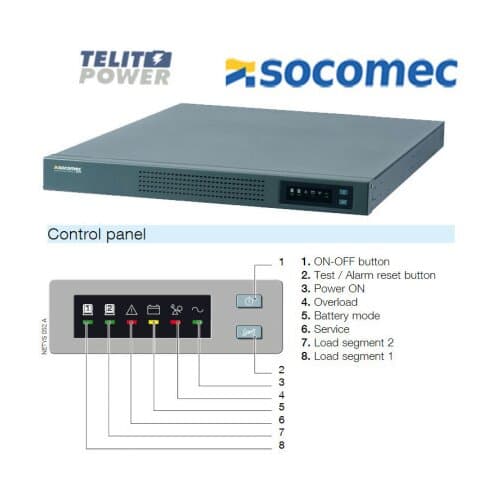
The NeTYS PR is the unit to specify when several tanks, a shared sump or a small aquaculture setup all hang off one protected circuit and downtime costs real money. It is a 1500VA line-interactive design at 230V with sinusoidal output and proper power conditioning, sold through electrical distribution rather than consumer retail — which is reflected in both the price and the expected service life. For a single home aquarium it is more machine than the job needs; the Eaton or CyberPower will do the same work for a fraction of the outlay. Specify the variant carefully, as the NeTYS PR family covers tower, rack and rack/tower models with different outlet counts and battery arrangements.
All five are 230V UK-market units with automatic voltage regulation and enough capacity to keep an air pump, filter and controller running through a typical outage. They separate on two things: output waveform — only the CyberPower is a true sine wave — and build life, where the Riello and Socomec are installation-grade rather than desktop units.
What a UPS can actually run on an aquarium
Aquarium equipment splits cleanly into loads a battery can carry and loads it cannot. Air pumps, small powerheads, solenoids and controllers draw single-digit to low tens of watts and will run for a useful stretch. Heaters draw 100-300W continuously and will flatten any of these units in minutes, because a UPS is sized as a brief bridge rather than a heat source. Size the unit to the pump and controller load, leave the heater on the unprotected side, and insulate the tank if the outage runs long.
Air pumps and controllers draw roughly 2-10W, so capacity is rarely the constraint; a 200-300W heater is the load that empties the battery.
Runtime figures are quoted at half load — APC rates the 900W BX1600MI at about 6.7-7.7 minutes at 450W, which is the honest number to plan around.
Inverter overhead matters more than the pump does: these units draw power simply being switched on, so real-world runtime is well short of what watt-hours alone suggest.
Pure sine-wave output suits controllers and DC or variable-speed return pumps; the CyberPower CP1500EPFCLCD is the only true sine-wave unit here, while the BX1600MI puts out a stepped approximation and the Riello NPW 1000 a pseudo-sine wave.
None of these five has genuinely hot-swappable batteries — the Back-UPS, the 3S and the NPW all need taking offline to change cells.
A UPS is not an RCD. Keep the aquarium circuit on a 30mA RCD; the UPS provides surge and voltage regulation, not earth-fault protection.
Mount the unit above tank level and clear of splash and condensation — these are indoor electronics sitting beside open water.
All five are 230V with IEC or UK connections. North American 120V models will not run on UK mains, whatever the VA rating suggests.
Frequently Asked Questions
Can a UPS run my aquarium heater during a power cut?
Not for long, and it is not what a UPS is for. A 200-300W heater is a continuous resistive load; APC rates the 900W BX1600MI, the largest unit here, at roughly 6.7-7.7 minutes at 450W. Put the air pump, filter and controller on the battery-backed outlets, leave the heater on unprotected mains, and insulate the tank with a lid and a blanket instead.
Which of these is best for a typical home aquarium?
The Eaton 3S 700 (700VA/420W) covers an air pump, a filter and a controller for most single-tank setups at the lowest cost. Step up to the APC Back-UPS BX1600MI (1600VA/900W) only if a large return pump also has to stay running.
Do I need a pure sine wave UPS for an aquarium?
Only if a controller, a DC pump or a variable-speed return pump is on the protected side — those can hum, run hot or refuse to start on a stepped output. The CyberPower CP1500EPFCLCD is the only true sine-wave unit on this list; the APC BX1600MI outputs a stepped approximation and the Riello NPW 1000 a pseudo-sine wave.
How long will one of these keep an air pump running?
An aquarium air pump draws roughly 2-5W, so the pump itself is almost irrelevant to the maths. The inverter's own consumption dominates, which is why real runtime lands in the low hours rather than the dozen that watt-hours alone would imply — and less than that on a battery more than three years old.
Conclusion
Choose on watts and waveform, not on the VA badge. The Eaton 3S 700 (700VA/420W) is the cheapest way to keep an air pump, a filter and a controller alive overnight, and it covers most single-tank setups. The APC Back-UPS BX1600MI (1600VA/900W) buys headroom for a larger return pump, though its rated 6.7-7.7 minutes at half load shows what that headroom is really worth against a heavy load. The CyberPower CP1500EPFCLCD (1500VA/900W) is the one to fit when a controller or a DC return pump is on the protected side, because its output is a genuine PFC sine wave rather than an approximation. The Riello NetPower NPW 1000 (1000VA/600W) and the Socomec NeTYS PR 1500VA are installation-grade line-interactive units with better components and longer service lives, aimed at fish rooms and multi-tank setups where a call-out costs more than the UPS did. Whichever you fit, plan the outage rather than the purchase: pump on battery, heater off, lid on, a blanket over the glass, and a battery air pump in the cupboard as the backup to the backup.