

Top 6 Sensory Feedback Insoles and Wearables in the UK — 2026 Guide
Published on Wednesday, 25 February 2026
Short answer first: the six devices below fall into two very different groups. Walkasins is a prescription sensory neuroprosthesis - RxFunction supplies it through clinicians who assess and fit it, not through retail, and we found no UK consumer listing for it. Moticon ReGo is research- and clinic-grade equipment priced accordingly. Arion, Stridalyzer Insight and Sensoria Core are consumer sports wearables: they measure gait and cue cadence, and they are sold as training tools, not as treatments for a balance disorder, neuropathy or falls. NURVV Run is included for reference only - NURVV Limited was dissolved in January 2025, so the insoles are no longer manufactured or supported. If you are buying because of a balance problem, dizziness, numb feet or a fall, speak to a GP, physiotherapist or podiatrist first; none of the consumer devices here can diagnose or treat those conditions. Sensory feedback insoles and wearables are a fast-growing category within Recovery Therapy Equipment > Rehabilitation Mobility Stretching Aids > Balance And Gait Training Aids in the United Kingdom. These devices combine pressure sensors, inertial measurement units, and small actuators to deliver vibrotactile, auditory, or haptic cues in real time, helping users correct posture, reduce sway, refine gait patterns, and build safer movement habits. In the UK market the category appeals to a wide range of buyers: clinicians and rehabilitation programmes seeking fall-risk interventions, older adults and people with peripheral neuropathy or vestibular deficits, athletes and runners looking for cadence and technique feedback, and tech-savvy consumers who want data-driven training and remote monitoring. UK buyers increasingly prioritise robust sensor accuracy, comfortable and climate-appropriate form factors that fit British footwear, strong app ecosystems and analytics, clear privacy policies, and published clinical support. As telehealth and publicly funded rehabilitation pathways expand across counties, demand for remote-capable, easy-to-use sensory insoles and body sensors has grown, making these wearables practical for both clinical and home use in 2026.
Top Picks Summary
Walkasins Sensory Neuroprosthesis
Walkasins is a prescription sensory neuroprosthesis from RxFunction, not a consumer insole. A foot-mounted sensor reads plantar pressure and an ankle-worn unit delivers matching vibrotactile cues, substituting for the sensation lost in sensory peripheral neuropathy. It is supplied through clinicians who assess, fit and follow up the user, and we found no UK retail availability - buyers outside the United States should expect to go through a practitioner. That care-pathway focus, plus a price well above consumer insoles, is why it suits rehabilitation programmes and clinically supervised fall-risk work rather than general fitness use.

£2,650 – £3,710
Arion Smart Insoles
Arion Smart Insoles differentiate themselves with an emphasis on intuitive haptic feedback and lightweight consumer ergonomics, offering a competitively priced entry into real-time tactile cueing compared with more clinical or research-grade systems. Technically they focus on immediate sensory cues and low-latency wearability, making them attractive for everyday users and athletes who want actionable feedback without the higher cost of medical devices. In the sensory feedback insoles and wearables category, Arion represents a strong mid-market option that balances technical responsiveness and affordability.
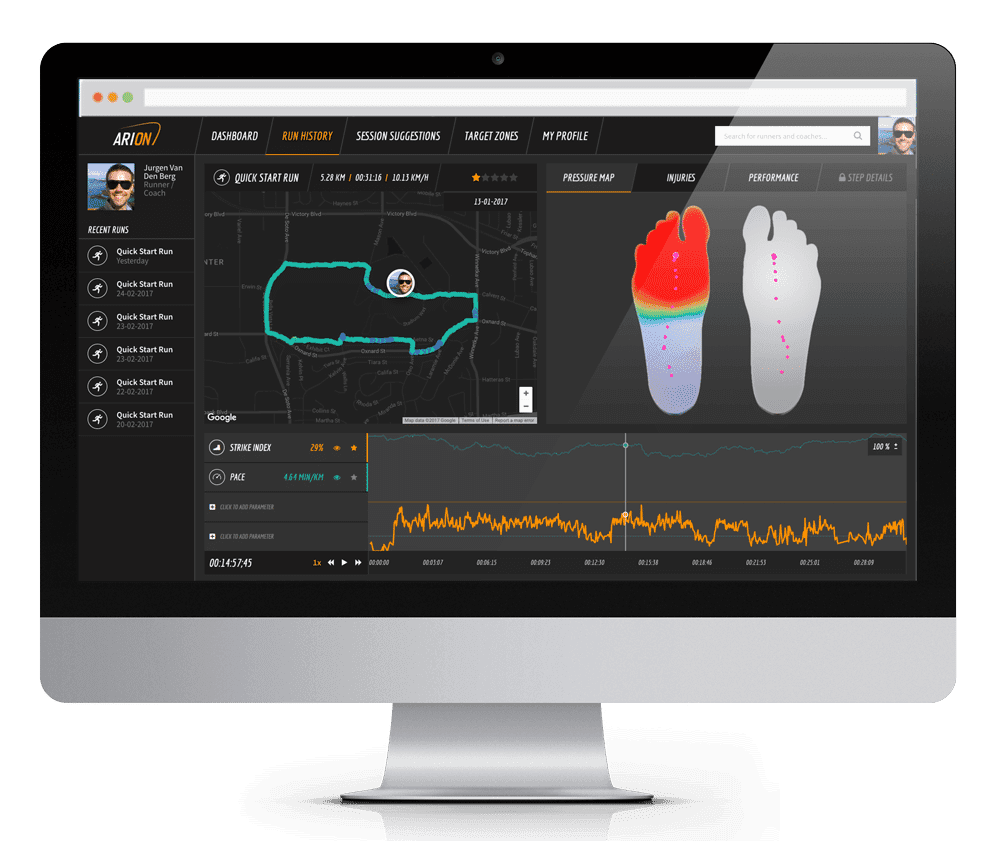
£265 – £371
Nurvv Run Smart Insoles
NURVV Run pairs 16 pressure sensors per insole with live coaching to produce high-resolution cadence, footstrike, contact-time and pronation data - genuinely more detailed than insoles that only buzz. The important caveat is commercial, not technical: NURVV Limited, the London company behind the product, was dissolved in January 2025, so the insoles are no longer manufactured and app and cloud support should not be assumed. Treat any remaining stock as an unsupported purchase and check what still works before spending.

Moticon ReGo Sensor Insoles
Moticon ReGo Sensor Insoles are recognized as a research- and clinic-grade solution with full wireless, validated pressure-sensing arrays that outperform many consumer products on raw measurement accuracy and integration in gait labs. Their technical strengths and enterprise-oriented pricing make them a preferred choice for clinicians and researchers over cheaper consumer wearables that lack rigorous validation. For sensory feedback insoles and wearables, Moticon ReGo is the leader when high-fidelity measurement and seamless lab integration are required despite a higher acquisition cost.

£1,060 – £2,120
Stridalyzer Insight Smart Insoles
Stridalyzer Insight Smart Insoles earn a best-in-class spot for their high-resolution pressure mapping and focused gait analytics, delivering clinical-style metrics and long battery life that make them cost-effective for repeated assessments in both practice and research settings. Compared with the other products in this list, Stridalyzer emphasizes denser sensor arrays and integration with rehabilitation platforms, giving a technical edge for precise biomechanics work while remaining competitively priced for organizations seeking accurate data without large recurring fees. For sensory feedback insoles and wearables, it balances technical fidelity and per-unit affordability.
Sensoria Core Smart Socks
Sensoria Core Smart Socks remain a market leader thanks to their mature consumer ecosystem, washable textile sensors, and seamless smartphone connectivity that appeal to everyday athletes and large-scale deployments. Compared with Stridalyzer, Sensoria offers broader app support, a larger user community and proven reliability in field use, though it typically commands a premium due to ongoing firmware and cloud-service features; this makes it the stronger choice when ease of use and post-purchase software support matter for sensory feedback insoles and wearables. The product's commercial strength is its polished end-to-end experience and established brand presence in wearable performance monitoring.
£89 – £139
What the research shows
Scientific studies, pilot trials and clinical evaluations have explored how sensory feedback and wearable sensors support balance and gait training. Results generally indicate measurable improvements in balance metrics, gait symmetry, and step cadence when feedback is paired with guided training, though outcomes vary by device, user population, and training protocol. Research also highlights the value of objective, continuous data collection for remote monitoring and rehabilitation progress tracking.
Balance improvements: Trials using vibrotactile or sensory substitution systems report reductions in sway and improved postural control for people with sensory loss or vestibular deficits.
Gait symmetry and cadence: Pressure-sensing insoles that provide real-time cues can help users correct asymmetry and maintain target cadence, which is useful for both rehabilitation and athletic training.
Remote rehabilitation: Studies of tele-rehab programs that incorporate wearable sensors show that remote coaching plus objective data can maintain or accelerate functional gains compared with unsupervised home exercise.
Device and protocol dependence: Effect sizes differ across technologies and populations; sensor accuracy, feedback timing, and the quality of coaching or app guidance strongly influence outcomes.
Safety and adherence: Comfortable fit, clear instructions, and unobtrusive feedback are associated with higher adherence in older adults and clinical populations.
Frequently Asked Questions
Which sensory insole helps balance impairment most effectively?
Walkasins Sensory Neuroprosthesis has the strongest clinical evidence base of the devices here: it reads foot pressure and delivers vibrotactile cues at the ankle to substitute for lost sensation in people with sensory peripheral neuropathy. It is a prescription device, supplied and fitted through a clinician after an assessment rather than bought over the counter, and we found no UK consumer listing for it. The other devices on this page are sports and activity wearables and are not sold as treatments for balance impairment.
Do NURVV Run Smart Insoles track cadence and footstrike?
Yes - NURVV Run insoles capture cadence, footstrike, ground contact time and pronation, with real-time coaching and post-run analysis in a paired smartphone app. Rating is 4.2. Be aware before buying that NURVV Limited, the UK company behind them, was dissolved in January 2025, so remaining stock is unsupported and the app and cloud service should not be assumed to still work.
Is Arion Smart Insoles good value versus clinical systems?
Arion sits well below clinical and research-grade systems on price while still giving real-time haptic cueing for cadence and stride from embedded pressure sensors and IMUs. Rating is 3.8. It is a running performance product from ATO-GEAR in Eindhoven, the Netherlands - useful for technique work, but not a substitute for a clinician-fitted balance device.
Who are Walkasins for, and who should not buy them?
Walkasins is intended for adults with balance and mobility problems caused by sensory peripheral neuropathy, under supervised clinical fitting and long-term daily use. It is not a consumer fitness product: it is not intended for runners looking for gait analytics, it is not a general fall-prevention gadget for anyone worried about balance, and it cannot be self-prescribed. Rating is 4.1. If you have numbness, unsteadiness or a history of falls, the first step is a clinical assessment, not a purchase.
Conclusion
In the UK context these sensory feedback insoles and wearables serve two separate audiences, and it is worth being clear about which one you are in. The devices covered here are Walkasins Sensory Neuroprosthesis, Arion Smart Insoles, NURVV Run Smart Insoles, Moticon ReGo Sensor Insoles, Stridalyzer Insight Smart Insoles, and Sensoria Core Smart Socks. Walkasins is the strongest option for clinically supervised fall-risk work in people with sensory peripheral neuropathy, but it is a prescription device: it is obtained and fitted through a clinician after an assessment, not bought online, and availability outside the United States is limited. Moticon ReGo is aimed at clinics and research labs at a matching price. Arion, Stridalyzer Insight and Sensoria Core are consumer training wearables for cadence, stride and activity data. NURVV Run remains widely written about, but its manufacturer was dissolved in January 2025, so treat any remaining stock as unsupported. You can refine or expand your search using the site search to compare features, clinical evidence, price, or form factor.