

Top 6 Equine Wearable Activity and GPS Trackers in the UK for 2026
Two of the six devices on this page are no longer buyable: Hylofit closed and its domain is now parked for sale, and Trackener, the London company behind the girth-sleeve monitor, has ceased trading. Both are kept here as reference points, not recommendations. Equestrian diagnostic monitoring devices sit at the intersection of equine first aid, performance training and theft prevention. In the UK market these wearables and trackers combine accelerometers, gyroscopes, heart-rate sensors and GPS to deliver continuous, objective data on movement, gait, fitness and precise location. British owners, trainers and veterinary professionals value devices that tolerate wet winters, rough terrain and long turnout periods, so robustness, battery life and reliable offline or cellular fallback are key purchase drivers. Consumers also look for validated analytics that feed directly into veterinary rehabilitation plans, simple mounting on existing tack, clear reporting dashboards, and transparent subscription and data privacy terms. Whether you manage a competition yard, a livery in the Home Counties or horses turned out on moorland, these devices help spot early lameness, quantify training load, and recover missing animals, making them an increasingly essential part of modern equine care.
Inception's AI took the time to understand this market in the UK · · How we pickWe may earn a commission on purchases. It never affects our rankings.
Top Picks Summary
Hylofit Heart Rate Monitor and GPS Tracker
Hylofit paired a girth-mounted heart-rate belt for the horse with a chest strap for the rider and combined both with GPS on one screen, which made it a favourite for endurance and eventing conditioning work. It is no longer a buyable option: the company has shut down and hylofit.com now resolves to a domain-sale placeholder, so the app and the cloud analytics the system depended on are gone. Secondhand units surface occasionally but have no service behind them. It stays on this page as a reference point for what combined HR plus GPS looked like, not as a recommendation.

Estimated£300 – £450
Trackener GPS Tracker for Horses
Trackener was a London startup whose sleeve-mounted unit sat on the girth and reported location, geofence breaches and turnout activity over its own cellular connection, which made it a sensible mid-priced option for large or remote UK properties. The company has since ceased trading, so the subscription service the tracker reported through is no longer operating and the device is not available new. Listed here for comparison rather than as a current buy; for live tracking choose a device whose provider is still supporting the SIM and app.

Estimated£220 – £320
Equisense Motion S Sensor
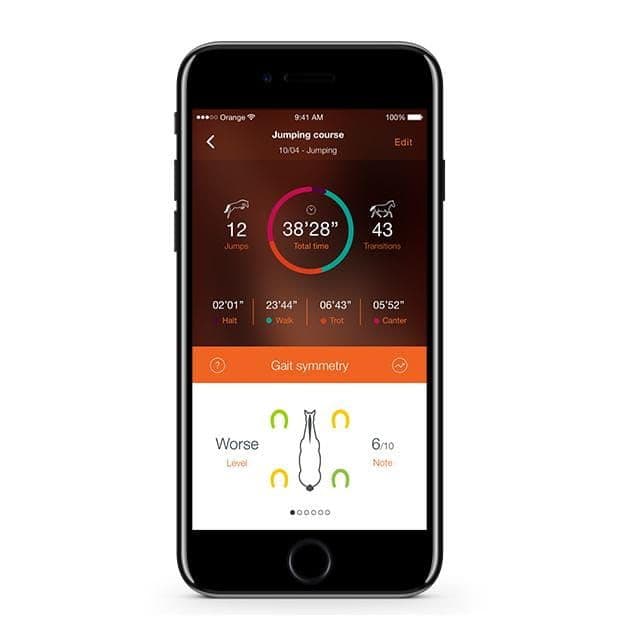
The Equisense Motion S is the strongest current option here for training and rehabilitation data. The sensor clips to the girth and derives stride length, cadence, regularity and left/right symmetry across the session, then presents it as trends you can hand to a vet or trainer. Against Seaver it is more focused on biomechanics than on physiology, and against the locators on this list it does no positioning at all — it is a movement sensor, not a tracker. It sits at a premium price and needs recalibration when you move it between saddles.
Seaver Smart Girth
Seaver's girth-mounted sensor takes the physiological route rather than the biomechanical one, logging heart rate, respiratory rate, stride and workload continuously through the session and turning it into training-load summaries. It is cheaper than the Equisense Motion S and better suited to conditioning work than to gait screening. Note that Seaver's current sensor line is sold under the CEEFIT name, so check which generation a listing refers to before buying, and check girth sizing — fit complaints are the most common criticism.

Estimated£180 – £260
EquiTrace GPS Tracker
EquiTrace, based in Co. Kildare, Ireland, is an equine identification and health-record system built around microchip scanning and a mobile app rather than a satellite locator. It is genuinely useful for proving identity, logging medication and movement records and managing a yard's paperwork, and that identity trail matters in a theft or straying case. It does not, however, give you live position on a map: if location tracking is what you need, pair it with a cellular GPS unit. Anyone shopping this page for anti-theft should read it as a records tool, not a tracker.

Estimated£120 – £220
Apple AirTag
The AirTag is the cheapest locator here and the easiest to set up, but it is important to be clear about what it does: it has no GPS and no SIM, and reports a position only when someone else's iPhone passes close enough to pick up its Bluetooth signal. In a town, a busy yard or a lorry park that works well; on a quiet bridleway or moorland turnout it can stay silent for a long time, which is the exact situation horse theft happens in. Use it for tack, rugs, a trailer or a horsebox, and use a cellular GPS unit if you need to find a horse in a field.

What these devices actually measure, and where they stop
Equine wearables fall into three groups that are easy to confuse when shopping. Inertial sensors (accelerometer plus gyroscope) sit on the girth or saddle and derive stride length, rhythm, cadence and left/right symmetry from motion. Heart-rate devices use electrodes against the skin under the girth to report working heart rate and recovery. Locators are a separate category again: true GPS units carry their own satellite receiver and a SIM to report position, while Bluetooth tags such as the AirTag carry neither and only report a position when someone else's phone passes within range. A device from one group cannot do the job of another, and none of them diagnose anything on their own — they produce trend data a vet or trainer interprets alongside a hands-on exam.
Symmetry numbers are a screening signal, not a lameness diagnosis: a sensor can flag that a horse's left/right motion has changed week on week, but the cause still needs a clinical workup.
Heart-rate readings depend almost entirely on electrode contact. Dry hair, a loose girth or a thick winter coat produce dropouts and implausible spikes; wetting the contact area is the usual fix.
Bluetooth tags such as the AirTag depend on passing iPhones. On a moorland or a remote field with no footfall, they will not report a position, which is exactly the scenario horse theft happens in.
Cellular GPS units need a live SIM and a subscription. If the company behind the device stops trading, the hardware usually stops reporting too, which is what happened to owners of the discontinued devices on this list.
Mounting and waterproofing decide real-world reliability more than sensor specs do. Check the IP rating, how the unit attaches to a girth, rug or headcollar, and whether it survives a horse rolling on it.
Frequently Asked Questions
Which tracker should I choose for lameness flagging UK?
The Equisense Motion S Sensor. It clips to the girth or saddle and reports stride, tempo and left/right symmetry, which is the data that flags a change worth investigating, and it holds a 4.5 average rating here. The Hylofit heart-rate unit previously listed for this job is discontinued — the company has closed — so it is no longer a usable option. Treat any sensor output as a prompt for a vet exam, not a diagnosis.
Does the Equisense Motion S Sensor measure gait symmetry?
Yes—the Equisense Motion S Sensor clips to the girth or saddle and provides real-time gait and symmetry metrics, with 4.5 average rating and Bluetooth connectivity plus a companion app and cloud dashboard.
Is Trackener GPS Tracker cheaper than Hylofit for UK?
Trackener sat lower at roughly £220-320 against Hylofit's £300-450, but the comparison is academic: both companies have shut down, so neither device can be bought new and neither app or subscription service is still running. If you want a working tracker in that price band, look at the current sensor options on this page instead.
How does Trackener GPS handle theft deterrence in fields?
Trackener's unit offered live location, geofencing and movement history in a rugged waterproof housing that mounted to tack, a rug or a headcollar, and it holds a 4.3 average rating here. Note that Trackener has ceased trading, so the tracking service behind those features is no longer operating and the device cannot be bought or activated new.
Conclusion
Two entries here are historical rather than shoppable. Hylofit shut down and its website is now a parked domain, and Trackener has ceased trading, so the apps and cloud analytics both depended on are gone; secondhand units are effectively inert. Of the remainder, the Equisense Motion S is the pick if you want gait and symmetry analytics for training and rehab work, Seaver's girth-mounted sensor if you want continuous physiological data during sessions, and an Apple AirTag only as a cheap tack, rug and trailer locator rather than a field GPS. EquiTrace is an Irish app and microchip-scanning system for equine ID and health records rather than a location tracker, so pair it with a separate GPS unit if theft recovery is your goal. If you want to refine or expand the results you can search again by battery life, mounting type, veterinary integrations or price.